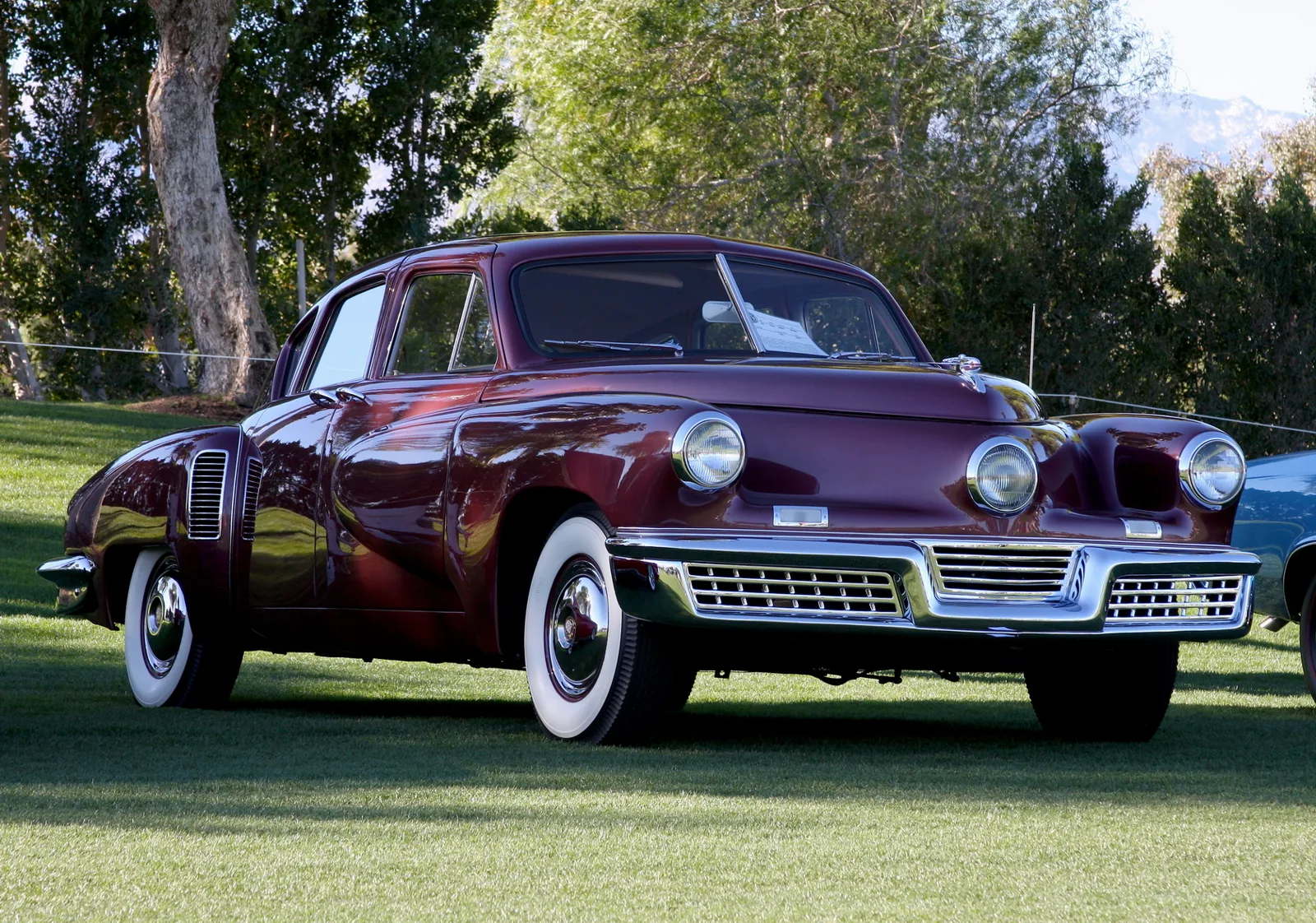
Preston Tucker's 1948 car brought a rear engine, a third headlamp, a padded crash chamber and a roll bar to American showrooms, then ended after 51 cars and a stock trial.
The Tucker 48, called the Torpedo in its early days, was a rear-engined 1948 car from Preston Tucker, built in Chicago. Only 51 cars were made before production stopped on March 3, 1949, after a press storm, an SEC investigation and a stock fraud trial.
Preston Tucker dreamed up the Tucker 48, known to many as the Torpedo, in Ypsilanti, Michigan. Production ran for a short time in 1948 in Chicago, Illinois. Only 51 cars were made, including the prototype, before the company was forced to stop on March 3, 1949, under pressure from the press, the Securities and Exchange Commission and a heavily publicised stock fraud trial.
Where did the Tucker 48 come from?
After the Second World War the public wanted new cars, but the Big Three Detroit makers had not produced an all-new model since 1941 because their factories had been turned to war work. Smaller companies could develop designs faster than the large legacy firms, and Tucker set out to build a safer car with modern styling and advanced engineering.
His brief asked for a water-cooled aluminium flat-six behind the seats, plus disc brakes, independent suspension on all four wheels, fuel injection, controls within easy reach of the driver, seat belts and a padded dash. Several of these ideas were abandoned during development, but the design ambition remained.
Tucker suspected that the established carmakers and Michigan Senator Homer S. Ferguson had played a part in his company's downfall. Tucker never proved the claim, and the question remains a subject of debate.
A rear-engined car with a third headlamp and a crash chamber that never got past 51 built examples.
How was the Tucker 48 styled?
Preston Tucker hired the car designer George S. Lawson in the summer of 1944, and Lawson spent roughly eighteen months on the design before it was shown publicly. Lawson was named chief stylist in February 1946, but he resigned in December 1946 after a disagreement with Tucker.
Alex Tremulis of the Chicago design firm Tammen and Denison took over and developed Lawson's design further, and the company's advertising showed the result in March 1947. Tucker then hired a team of five designers from the New York firm J. Gordon Lippincott, and the two groups built full-size clay models side by side.
The passenger side of the Lippincott model, which incorporated the profile Tremulis had already developed, was chosen almost unchanged for production. Tremulis was later rehired and is credited with dubbing the first prototype the Tin Goose, a name that was once derogatory but is now used affectionately.
What safety features did the Tucker 48 have?
The car is best known for its central third headlamp, which swivelled to light the road around corners. It switched on when the steering turned by more than 10 degrees, and Tucker made a cover for it because 17 states had laws limiting cars to two headlights.
The body sat on a perimeter frame with a roll bar integrated into the roof, and the steering box sat behind the front axle, which shielded the driver in a head-on impact. Every instrument and switch could be reached without leaving the wheel, and the dash was cushioned.
Safety glass made up the windscreen, which was built to detach outward during a crash and spare the people inside. The doors ran up into the roof for easier access, and a separate key locked the handbrake against thieves. A padded area in front of the passenger seat, known as the crash chamber, gave the front passenger room to brace in an accident.
Several other ideas were dropped along the way: magnesium wheels, brake discs, fuel injection, sealing tyres and a direct-drive torque converter in place of a gearbox.
Why was the Tucker 48 engine so troublesome?
Tucker first attempted a new engine, developed with help from Ben Parsons of the Fuelcharger Corporation, who later became Tucker's vice president of engineering. The unit displaced 589 cubic inches, had hemispherical combustion chambers and fuel injection, and used oil pressure instead of a camshaft to open its overhead valves.
The design aimed to idle at 100 rpm and cruise between 250 and 1200 rpm, with a torque converter on each driving wheel in place of a gearbox. The target was almost 200 hp and 450 lb ft of torque at 1800 rpm, and at 60 mph (100 km/h) the engine would turn only near 1000 rpm.
The engine did not perform as planned. The valve train proved problematic, and the unit produced only about 88 hp (66 kW). The engine demanded a 24-volt electrical system, with as much as 60 volts needed to start it, and the cranking took a long time. Six prototypes were built, but the engine went into only the test chassis and the first prototype.
What replaced the 589 engine?
After nearly a year of trying to make the 589 work, Tucker looked for an alternative. The Lycoming aircraft engine would not fit the rear compartment, but the air-cooled Franklin O-335 flat-six, made by Air Cooled Motors for the Bell 47 helicopter, did fit and delivered 166 hp.
| Engine | Power | Outcome |
|---|---|---|
| 589 cubic inch flat-six | Target of almost 200 hp; about 88 hp achieved | Abandoned after six prototypes |
| Lycoming aircraft engine | Not suitable | Would not fit the rear compartment |
| Franklin O-335 flat-six | 166 hp, converted to water cooling | Adopted for production |
Tucker bought four Franklin samples for $5,000 each and had his engineers convert the 334 cubic inch engine to water cooling, a decision historians have found puzzling ever since. The modifications were extensive, and very few parts of the original engine survived. Its durability was checked by running it flat out for 150 hours, which the engineers equated to 18,000 miles at full throttle.
Tucker purchased Air Cooled Motors for $1.8 million, a move that secured his engine supply, and then wound up its aircraft work so the firm could focus on car engines. That aviation trade had been enormous, since the firm once held 65% of such contracts, and giving it up was costly.
How was the transmission problem solved?
The engine needed a transmission to match its layout. Engineers found that the front-wheel-drive Cord 810 and 812 gearbox could be adapted, and the company gathered 22 used units from junkyards and dealers. Ypsilanti Machine and Tool refurbished them, and 18 of the 22 were installed in production cars as an interim solution.
Meanwhile, Ypsilanti Machine and Tool began redesigning the gearbox for mass production. The result was the Y-1, which kept the basic indirect layout but used new gearing, shafts and electro-vacuum controls. The company also worked on a more sophisticated continuously variable unit.
For that unit, the Tuckermatic, Tucker consulted Warren Rice, creator of the Buick Dynaflow. It had a single rear-mounted torque converter and 27 basic moving parts, about 90 fewer than a typical contemporary automatic. Three builds existed, labelled R-1, R-1-2 and R-3; the middle build went only to cars 1026 and 1042.
How was the suspension designed?
Tucker used an elastomer, or rubber, four-wheel independent suspension, similar to the race cars he had developed with Harry Miller for the Indianapolis 500. The rubber elements were developed with help from the Firestone Tire Company, and each one was vulcanised to a specific spring rate.
The suspension was severely stiff through development, which helped handling but caused the front wheels to lift on uneven surfaces. Cars 1001 and 1002 used a rubber torsion tube design that suffered from severe toe-in under heavy braking, and cars 1003 to 1025 used a rubber sandwich arrangement that was also stiff. From car 1026 Tucker settled on a modified torsion tube with the braking problem corrected.
How did Tucker raise money?
Tucker raised $17,000,000 through one of the first speculative public share issues, and he sold dealerships and distributorships across the country. The Tucker Accessories Program added $2,000,000 more by selling seat covers, radios and luggage in advance.
Those accessory sales gave buyers a place on the dealer waiting list. After the war, demand for new cars outran dealer supply, and veterans had priority, so the program offered a guaranteed spot to people who would otherwise wait indefinitely.
What happened at the premiere?
The world premiere was set for June 19, 1947, and over 3,000 people arrived at the Chicago factory, where they were offered a meal, a rail tour of the works and a look at the first prototype. Problems appeared the night before, when two independent suspension arms snapped under the weight of the car.
The experimental engine was extremely loud, so Tucker had the band play as loudly as possible. The high-voltage starter needed outside power, so the engineers kept the engine running throughout the event. Columnist Drew Pearson labelled the car a fraud, claiming it could not reverse and made a goose-geese noise on the road. The problem was confined to the first prototype, but the damage was already done.
Why did the Tucker company fail?
Tucker's bids for two steel mills, needed to supply raw materials, were rejected by the War Assets Administration. The press turned against the company, and the Securities and Exchange Commission investigated the accessory scheme, which led to an indictment of company executives.
The charges were eventually dropped, and Tucker was cleared in January 1950, but the bad publicity had already destroyed the company. Production stopped on March 3, 1949, and the company never recovered.
How many Tucker 48s survive?
Of the 58 frames and bodies built at the factory, 36 sedans were finished before the plant closed. After it closed, Tucker kept a core of workers who assembled 14 more sedans, bringing the total to 50, with a 51st partially finished.
In the early 1950s the Fort Lauderdale fairgrounds owner Nick Jenin bought more than ten Tuckers, the original testbed chassis and many parts, and he toured the cars as a display called The Fabulous Tuckers for nearly 10 years. When cars come up for auction they fetch prices reserved for a few marquee vehicles. Tucker #1045 sold for $1.127 million in August 2010, and #1043 went for $2.915 million in 2012.
Were there Tucker replicas?
Work on a replica began at Rob Ida Automotive in 1997, and the company released the New Tucker 48 in 2001. It reproduces the outer body but rests on a hot-rod chassis with resin-infused plastic panels, and a Cadillac Northstar V8 sits mid-mounted behind the cabin.
Its claimed figures are 0-60 mph in 7 seconds and a top speed beyond 120 mph (190 km/h). Three have been built by the firm.
Did the Tucker 48 race?
Racing was never part of the plan, yet car #1004 made a brief appearance in NASCAR's Grand National series in the early 1950s. Endurance runs at the Indianapolis Motor Speedway also tested the cars, and during one of them car #1027 flipped three times at a speed of 95 miles per hour (153 km/h). Its driver escaped with bruises only.
Frequently asked questions
How many Tucker 48 cars were made?
Fifty-one cars were made, including the prototype, before production stopped on March 3, 1949. The 51st car was only partially completed.
How much did a Tucker 48 cost?
The original proposed price was $1,000, but the actual selling price came closer to $4,000. Tucker's accessory scheme also let buyers reserve a place on the waiting list for a car.
Why was the third headlamp important?
The centre lamp came on once the steering had turned past 10 degrees, lighting the road around corners. Because 17 states limited cars to two headlights, Tucker also made a cover for the centre light.
Is there a film about the Tucker 48?
Yes. The 1988 film Tucker: The Man and His Dream was based on the saga of the car's production, and Francis Ford Coppola, who directed it, owned a Tucker himself and showed the car at his winery.