About half of new US cars had gasoline direct injection by model year 2016. The same design that sharpens efficiency leaves the intake valves without a petrol wash, and carbon builds up.
Direct-injection petrol engines spray fuel into the cylinder, so no petrol washes the intake valves and carbon deposits can build up there. The fix used on some engines is a second set of port injectors, as on the Toyota 2GR-FSE and Volkswagen EA888, which also helps clean the intake.
In US model year 2008, 2.3 per cent of new vehicles used gasoline direct injection. By model year 2016, about half did. The design brings real gains in efficiency and power, and it also removes the petrol that used to wash over a car's intake valves, so carbon builds up there.
What is gasoline direct injection?
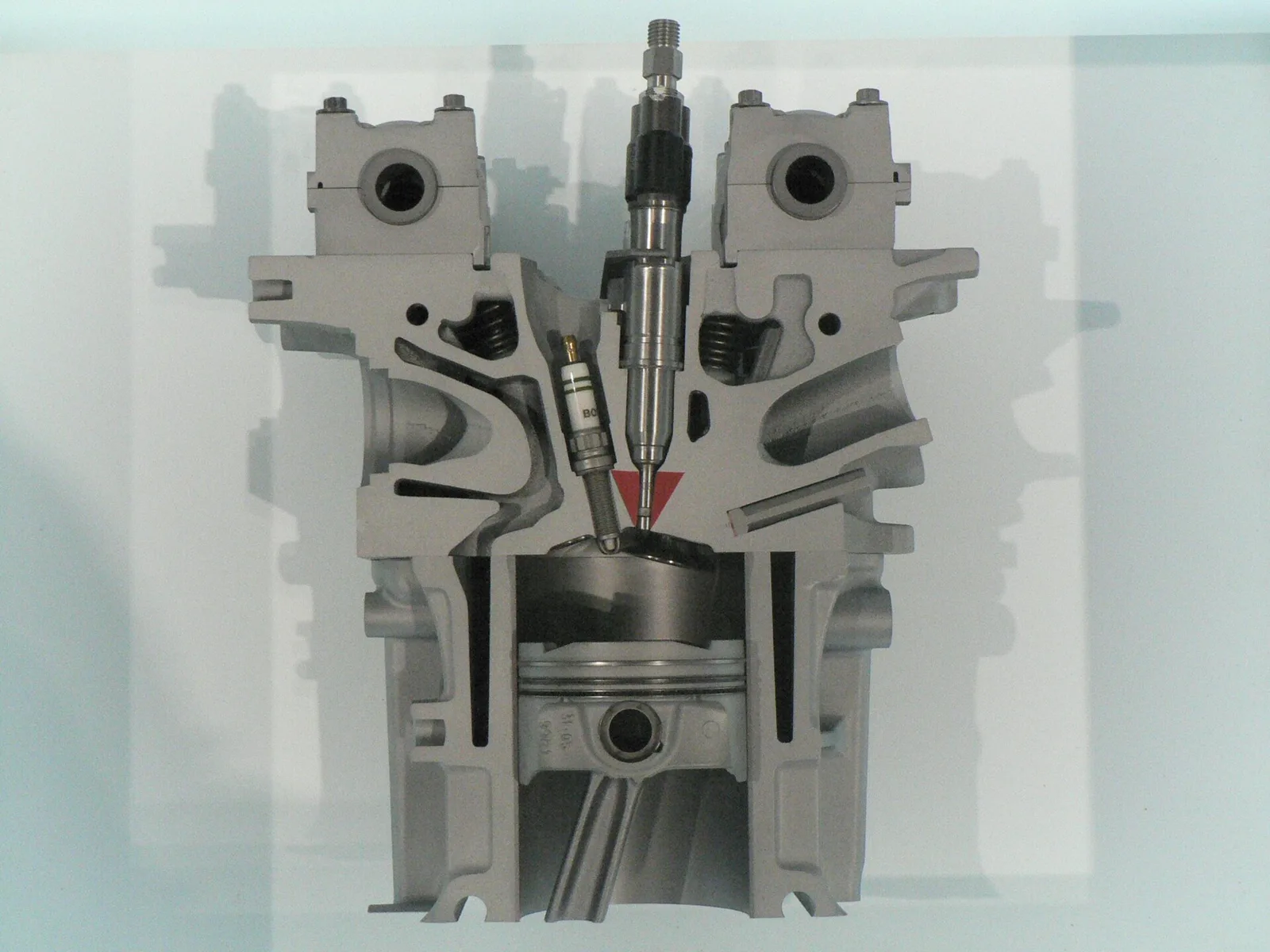
Gasoline direct injection, or GDI, is a fuel injection system that squirts petrol straight into the combustion chamber. Manifold injection, the older approach, adds the fuel to the intake manifold, where it mixes with the incoming air before it reaches the cylinder. It can sharpen efficiency and specific power, and cut tailpipe emissions as well.
The idea is nearly a century old. The first production engine to use it was the Swedish Hesselman engine, introduced in 1925. It was a low-compression multi-fuel design: petrol was expensive, so it was normally used only for starting, then the engine switched to a cheaper fuel. Bosch mechanical injection followed, and in 1936 the DB601 V12 in the Messerschmitt Bf 109 became the first GDI engine to reach mass production with it. That allowed extremely high compression ratios and high-pressure forced induction from petrol with an octane rating of only 87, and unlike carburetted rivals it did not stall in negative-G turns.
The contrast with the carburettor explains the appeal of any injection system. A carburettor depends on the suction of air speeding through a Venturi tube to pull fuel in, while an injector breaks the fuel into a fine spray by forcing it out of a tiny nozzle at high pressure. In a direct-injection engine only air is sucked in during the intake stroke, and the injection is always intermittent, timed either cylinder by cylinder or in sequence.
For cars, the technology stayed rare for decades. Several German cars used a Bosch mechanical system in the 1950s, and it was not until 1996 that Mitsubishi introduced an electronic GDI system for mass-produced vehicles. Since then the industry has taken it up widely.
In a port-injected engine, petrol sluices over the intake valves on its way in. In a direct-injection engine, nothing does.
Why does direct injection cause carbon build-up?
Because there is nothing to wash the intake valves. In an engine that injects upstream of the cylinder, petrol flowing through the intake port scrubs the valves of contamination, atomised oil among it. Direct injection gives no such valve-cleaning action, and the absence of it can cause increased carbon deposits.
Think of washing a plate under a running tap compared with wiping it with a dry cloth. In a port-injected engine the fuel is the running water. In a direct-injection engine the intake valves see only air, because air alone is drawn in during the intake stroke and the petrol arrives later, inside the cylinder. The intake manifold has the same simplified job, delivering just air to each intake port. Atomised oil is one of the contaminants that the petrol would otherwise carry off.
Carbon can come from combustion too. In spray-guided engines, where the injector and the spark plug sit close together, low piston speeds mean the air and fuel move slowly relative to each other. That can prevent proper vaporisation and produce a very rich mixture, and rich mixtures do not burn properly, which causes carbon build-up. Wall-guided engines have a different weakness: at low temperatures some of the fuel that lands on the cold piston cools so much that it cannot burn properly, producing high hydrocarbon emissions.
How do the injection systems compare?
| System | Where the fuel goes in | Effect on the intake valves | Limits |
|---|---|---|---|
| Direct injection (GDI) | Straight into each combustion chamber | Only air passes the valves, so no fuel cleaning | Less time to inject at high rpm; petrol injection pressure limited to about 20 MPa (2.9 ksi) |
| Multi-point (port) injection | Into each intake port, shortly before the valve | Petrol passes the valves and acts as a cleaning agent | Fuel can join the intake air whenever the engine needs it |
| Single-point (throttle-body) injection | One injector in a throttle body, mixed before the manifold | Fuel is mixed with the air before it enters the intake manifold | Low-cost way to cut emissions; used extensively on American cars from 1980 to 1995 |
How does fuel get into an engine at that pressure?
An injector is a spray nozzle, and it does the last of three jobs in a fuel system. Something has to pressurise the fuel, usually a pump. Something has to meter it, deciding how much goes in, and since the 1980s electronic systems have done that, with a modern engine control unit also managing ignition timing. Then the injector delivers it, whether into the combustion chamber, the inlet manifold, or sometimes the throttle body.
Common rail is the most common direct-injection system in modern automotive engines. Fuel goes from the tank to a shared header called the accumulator, which has a relief valve to hold the pressure and return the excess, and from there through tubing to the injectors, each opened and closed by a solenoid-operated needle valve. The pressures vary widely by fuel. Petrol injection is held to about 20 MPa, while diesels of the third generation have piezoelectric injectors for extra precision and run at up to 300 MPa (44,000 psi).
What is a dual-injection engine, and does it solve the problem?
A dual-injection engine pairs direct injectors with a second set of manifold injectors. Examples are the Toyota 2GR-FSE V6 and the Volkswagen EA888 four-cylinder. The manifold injectors supply extra fuel at high revs, and they have the side effect of cleaning carbon from the intake system.
The reason for the second set is a limit of direct injection itself. A GDI engine can inject only during the intake and compression phases, whereas port injection, a carburettor or throttle-body injection can add fuel at any time. When revs climb, each combustion cycle is shorter, there is less time to inject the required quantity, and peak power at high rpm is harder to reach. Adding port injectors solves that, and the same injectors incidentally give the valves a petrol rinse.
Another remedy is aftermarket. Aftermarket firms sell oil catch tanks aimed at preventing or lessening the deposits.
Which direct-injection engines behave differently?
The charge mode matters. In homogeneous mode the fuel is mixed evenly with air, much as in a manifold-injected engine, and the fuel goes in at the very start of the intake stroke so that it has as long as possible to blend with the air. Most direct-injected passenger car engines run this way. Fuel efficiency improves only slightly over manifold injection, but specific power is better, which is why the mode suits engine downsizing.
Stratified charge mode is the cleverer idea. A small zone of mixture forms around the spark plug, surrounded by air, so far less fuel is injected overall and the engine can run very lean at low loads. The throttle can stay open as far as possible, which avoids throttling losses, and torque is set by the quantity of fuel injected rather than the quantity of air. The flame also stays away from the cylinder walls, which reduces heat losses. In theory that cuts fuel use and emissions further. In practice it has failed to show any significant efficiency edge over the homogeneous approach, and its lean burn creates more nitrogen oxides, sometimes requiring a NOx adsorber that can need low-sulfur fuel. Stratified engines can also produce more particulate matter than manifold-injected ones, sometimes requiring particulate filters like those on diesels.
So many makers walked away from it. The 2009 BMW N55 and the 2017 Mercedes-Benz M256 dropped the stratified mode their predecessors had used. Volkswagen used it in naturally aspirated engines labelled FSI, then disabled it with an engine control unit update, while its turbocharged TFSI and TSI engines have always run in homogeneous mode. Most newer direct-injection petrol engines, from 2017 onwards, pair homogeneous mode with variable valve timing for good efficiency, and stratified concepts have mostly been abandoned.
Among the ways of placing the fuel, spray-guided injection is the trend, since it currently offers higher fuel efficiency. Air-guided injection relies on the intake air to carry fuel to the spark plug, which reduces charging efficiency and power, and most engines in fact blend the air-guided and wall-guided approaches. The tolerances for spray-guided engines are tight, because a small misalignment of the spark plug can drastically reduce combustion quality.
How did petrol injection reach the road?
Manifold injection came first on the road. Petrol injection arrived in passenger cars in the early 1950s and gradually spread, and the Bosch K-Jetronic, a continuous system introduced in 1974, stayed in use at various car makers until the mid-1990s. Racing showed what it could do: at the 1957 24 Hours of Le Mans the cars placed first to fourth were all Jaguar D-Types with Lucas fuel injection, and in the same year General Motors offered the Rochester Ramjet injection option on the Chevrolet Corvette V8.
Direct injection was tried several times, with mixed results. Archibald Low experimented with GDI in 1912 and gave the engine the misleading name Forced Induction Engine. Bosch developed the first petrol direct-injection system to be mass-produced, for small two-stroke car engines, and it appeared in the 1950 Goliath GP700. Bosch mechanical direct injection also went into the straight-eight of the 1954 Mercedes-Benz W196 Formula One car.
The following year came the first direct-injection four-stroke petrol engine in a passenger car, in the Mercedes-Benz 300SL. It suffered lubrication problems because petrol diluted the engine oil, and later Mercedes-Benz engines switched to manifold injection. Before the 2000s most petrol injection used that cheaper manifold layout, and carburettors had largely been replaced by fuel injection by the early 1990s. Use of direct injection in petrol engines became increasingly common in the 21st century.
What other drawbacks does direct injection have?
Petrol lubricates injector parts less well than diesel, which limits the injection pressure in GDI engines to about 20 MPa (2.9 ksi), so that the injectors do not wear out early. Peak power at high revs is also more limited, for the timing reason above.
Then there are particles. Although GDI is credited with boosting fuel efficiency and cutting CO2, GDI engines emit more black carbon aerosols than traditional port-injection engines, and black carbon soaks up solar radiation strongly, with a significant warming effect. A study published in January 2020 in Environmental Science and Technology from researchers at the University of Georgia predicted that the increase in black carbon from GDI-powered vehicles would raise climate warming in urban areas of the US by more than the cooling from reduced CO2. The same team estimated that switching from port injection to GDI would almost double the yearly toll of early deaths linked to vehicle emissions in the US, from 855 to 1,599, costing society an estimated $5.95 billion a year.