A 1906 Pennsylvania mile, Canada's only sanctioned hillclimb and a Portuguese road that draws some two hundred thousand spectators, plus a tour of America's mountain races.
Giants Despair is a 1.6 km Pennsylvania hillclimb running since 1906. Knox Mountain is Canada's only sanctioned hillclimb, in British Columbia. Falperra is a 5.2 km Portuguese climb on the FIA European calendar, run since 1927. US hillclimbing ranges from Pikes Peak to spectator-free Vermont events.
More than a century after the first winner of Giants Despair in Pennsylvania took 2 minutes 11.2 seconds, a 2012 Wolf GB08 covered the one-mile course in 35.602 seconds, the 2026 record. The hill, run since 1906 on East Northampton Street, rises 200 m (650 ft) at grades up to 20%. Nothing else in Pennsylvania motorsport has gone on so long.
Alongside it sit Knox Mountain in British Columbia, Falperra in Portugal and the wider story of US hillclimbing, from Colorado's Pikes Peak to Vermont's Mount Equinox, where many events keep spectators out.
How does hillclimbing work in the United States?
American hill climbs go back to the early days of motoring competition. A few copy the European template of a long mountain road, and a good many exclude or strictly limit spectators because of safety or insurance worries.
Pikes Peak
Pikes Peak, in Colorado, is billed as the world's premier hill climb, and its entrants have included Indy 500 champions and several world rally champions. The course runs 20.0 km (12.4 miles), takes in 156 turns and finishes at 4,300 m (14,100 ft). Romain Dumas holds the record, 7:57.148, set in 2018 in the Volkswagen I.D. R Pikes Peak. Smaller Colorado events run through the summer under the Colorado Hill Climb Association, at lengths from about 3 km (2 miles) to 8 km (5 miles).
The oldest American hill climbs
The oldest recorded official hill climb in the United States was Eagle Rock. It started in 1901 near what was then West Orange, New Jersey, organised by William K. Vanderbilt Jr, and officials shut it down in 1906 over safety fears. Anniversary races followed in 1951, 1956 and 1976, though they were ceremonial rather than competitive.
Climb to the Clouds, up the 11.9 km (7.4 mile) Mount Washington Auto Road in New Hampshire, was first run in 1904 and is one of the oldest motorsport events in North America. It has been held only sporadically since 1961 and was revived in 2011.
Mount Equinox
Mount Equinox, at Arlington in Vermont, climbs 5.2 miles up the mountain with 3,100 feet of elevation change and over 40 turns, and the long straight that ends at "The Saddle" sees cars timed at more than 100 mph. The roster of drivers includes Carroll Shelby, Briggs Cunningham, Rene Dreyfus, John Fitch and Miles Collier.
It began in 1950 as an official SCCA event and has run without a break since, now as a vintage car race. The Vintage Sports Car Club of America has sanctioned it since 1973. Bill Milliken won the first event in a front-wheel-drive Miller on a 6.25 mile shale road, in 6 minutes 59.4 seconds, an average of 54.2 mph. The course was paved in 1953.
Other American hills
- Chasing the Dragon, North Carolina: an annual SCCA event on the 3.7 km (2.3 mile) Maple Gap Road in the Nantahala Forests, first run in 2011. The King and Queen of the Hill receive a Dragonslayer sword, and spectators get in free. Justin Reed holds the overall record in a DF Kit Car Goblin, and Michele Aubele the women's record in a BMW 135i.
- Virginia City, Nevada: the first Martini Trophy Hillclimb was scheduled for 23 and 24 May 1964 and won by Stan Peterson in a Lotus 19. The current version dates from 1972, and the Ferrari Club Southwest Region event is its sole surviving annual running. Benn Godenzi set the record in a McLaren Senna in 2022, 3:03.766.
- Chimney Rock, North Carolina: run from 1956 to 1995. Early races covered 2.7 miles with 18 turns and a mandatory stop about halfway up. The course was cut to 1.9 miles in 1960, and to 1.8 miles in 1976 for safety.
- Georgetown, California: in 1966 Allen Grant won the ninth Georgetown Divide hillclimb in an A.C. Shelby Cobra, climbing Old Marshall Grade in 1:44.48 and beating Ray Seher's mark of 1:46.
- Other early New York events include Ellenville in 1957, won by Vernon Bennett's Jaguar XK140, and Dugdale Hill, Rochester, in 1906, won by Billy Knipper's Thomas in 51.8 seconds. At Hobo Hill, Dick Hoban's Porsche RSK held the absolute record of 38.8 seconds.
Regional organisations
The Northwest Hillclimb Association has run a series in the Pacific Northwest for several decades as a sanctioning body, with clubs hosting the hills. The calendar changes yearly as hills are added or lost to bad weather or road changes. Cars are classed mainly under SCCA Solo rules, with SCCA GCR, SOVREN Vintage and NHA Special classes also allowed.
In Vermont, the New England Sports Car Club Council brings together the Killington Sports Car Club, the Sports Car Club of New Hampshire and the Sports Car Club of Vermont. They run staggered-start timed trials on paved mountain access roads, under common New England Hillclimb Association rules. Club members and novices are welcome if the car passes technical inspection. Drivers must be over 18, wear a Snell-approved helmet and carry a 2.5 lb ABC fire extinguisher. The club's liability insurance covers damage to another car and any emergency medical treatment. A roll cage is not required unless a car beats a course's breakout time, and a driver who does so more than once needs a roll cage, fire suit and neck protection. The events take place on summer weekends, and spectators are prohibited, which the club enforces by renting the hills.
Giants Despair has run since 1906, and its one-mile record fell to 35.602 seconds in 2026.
What is the Giants Despair hillclimb?
Giants Despair dates to 1906 and is based at Laurel Run in Luzerne County, Pennsylvania, just outside Wilkes-Barre. The first running formed part of the city's centennial celebrations. No other motorsport event in the state has run for longer without a break, and it counts among the oldest continuing motor races anywhere.
The Giants Despair course
The road is a 1.6 km (1 mile) section of steep Pennsylvania mountainside. It climbs 200 m (650 ft) with grades up to 20%, and it has six turns, among them the 110 degree "Devil's Elbow".
A long, gently rising straight of about a quarter of a mile leads into a fast left-hander that tests nerve and skill. After a short chute comes Devils Elbow, a hairpin that climbs steeply and then tips off camber at the top. Ninety-degree turns joined by short straights follow. The last stretch, "The Incline", is a winding quarter mile that steepens to twenty-two degrees at the finish.
Giants Despair history and records
In its early years the biggest names in the car industry used the hill as a proving ground. Ralph DePalma drove for the Fiat team, and in 1909 Louis Chevrolet raced for Buick. He won Event No. 2, for gasoline stock cars selling from $851 to $1,250, in 2:34.4, although his car was the only entry. He is remembered mainly for a crash, when his Buick overturned and narrowly missed a group of people. He was not badly injured.
The hill was revived in 1951, and the list of drivers who tackled it grew to include Carroll Shelby, the first driver to break a minute, plus Roger Penske and Oscar Koveleski. In 1955 Bill Milliken took the AJB/FWD Butterball Special up in 63.771 seconds for third overall. In 2002 Ron Moreck broke the 40-second mark. Darryl Danko took the record at 38.360 seconds in 2007, and in 2026 Mark Aubele lowered it to 35.602 seconds in the Wolf GB08. The Pennsylvania Hillclimb Association runs the event on the second weekend of July.
The Pennsylvania Hillclimb Association
The SCCA sanctions every event in the state. Besides Giants Despair, the series includes the following hills.
- Duryea Hillclimb, Reading: 2.3 miles (3.7 km), the longest hill in the series, run by the Blue Mountain Region SCCA over the route Charles Duryea used to test his cars. It dates to 1951 and has speeds above 140 mph at the top. George Bowland holds the record, 105.528 seconds in 2008.
- Pagoda Hillclimb: a shortened Duryea course of 1.35 miles and nine turns, rising 410 feet. Ron Moreck holds the record, 73.213 seconds in 2023.
- Rose Valley, Trout Run, near Williamsport: run since 1967, 1.2 miles, with a steep hairpin called "Big Bend". Darryl Danko set the record, 51.770 seconds in 2006.
- Weatherly: hosted since 1960, with events that open and close the season. Its one-mile course has a feature called "the Wall" and a "Jump" where most cars leave the pavement. George Bowland set the record, 47.592 seconds in spring 2012.
- Polish Mountain: a PHA championship event near Gilpin, Maryland, about a mile south of the Mason-Dixon line. Bowland set the record there too, 50.708 seconds in 2008.
What is the Knox Mountain Hillclimb?
Knox Mountain is a yearly hillclimb in British Columbia's Okanagan Valley. It started in 1956 as the Okanagan Hillclimb and moved in 1966 to a paved road in Knox Mountain Park, Kelowna. Few annual hillclimbs in North America have run as long, and no other in Canada is sanctioned.
The Knox Mountain course
The 3.5 km (2.2 mi) course follows Knox Mountain Drive and climbs 245 m (800 ft), an average grade of 6.7%. It has nine turns, three of them hairpins. What makes it hard is that every corner is cambered to the outside of the curve, because the road was built as a mountain access route and designed for drainage of rain and meltwater, not for speed. It is the only course like it in the Pacific Northwest. The narrow road is lined with rock outcroppings, cliffs and mature trees, and the posted speed limit is 30 km/h (19 mph), yet the top racers exceed 160 km/h (99 mph) on the short straights.
The park covers 385 hectares (950 acres) overlooking downtown Kelowna. Organisers promote Knox as North America's longest-running annual paved hillclimb, a claim that Mount Equinox in Vermont may dispute.
How the event runs
Race weekend falls in May, on the Saturday and Sunday before Victoria Day. Knox Mountain Motor Sport organises it and belongs to the Confederation of Autosport Car Clubs, the FIA's sanctioning authority for British Columbia. Up to 90 drivers can take part, each needing a racing licence and safety equipment. Cars go up singly, grouped in classes that range from open-wheel machines and GT cars to vintage cars, four-wheel-drive cars, small engines of under 1800cc, dune buggies and electric cars. Whoever sets the quickest time overall is named "King of the Hill".
Anything under two minutes is considered exceptionally fast. By 2023 only 14 drivers had gone under 1:50, and that year Aran Cook set the record of 1:34.903. In 1969 Ron Allerton, sports editor of the Prince George Citizen, called Knox Mountain "the most perfect paved track" for a hillclimb in North America. In 1973 Hot Rod magazine named it the premiere event in Western Canada. The American racer George Bowland, who has held records at ten hillclimbs, said Knox was the best run he had attended.
Knox Mountain Drive is shut from the first frost warning of November until March or April, and normally in summer because of wildfire risk. It was closed to cars entirely during the COVID-19 pandemic. Since 2022 it has been open to cars only as far as the third turn, so racers can drive the full course only on race days and otherwise have to walk or cycle to inspect the upper half.
Cyclists use the same road: it has hosted the first stage of the K-Town Classic, which in 2008 drew 175 riders across three days, with a fastest ascent of 9:00. Downhill skateboarders and street luge riders use it for the Knox Mountain Downhill.
Knox Mountain history
In 1956 the Okanagan Auto Sport Club staged the first event at Penticton, on Crescent Hill Road. Westbank hosted it from 1957 to 1960, on a 1.8 km (1.1 mi) course that began at the shore of Okanagan Lake. Road repairs and realignment led to the cancellation of 1961. From 1962 to 1965 it used Camp Road in Okanagan Centre, a course of slightly over 1.6 km (1 mi), until crowds in the thousands outgrew that community.
The club was allowed to use the newly paved Knox Mountain road in 1966, and the benefits came quickly: all-day radio coverage on CKOV and television videotaping by CHBC. Popularity peaked in the early 1970s, with several thousand spectators and cash prizes from sponsors Castrol oil and Macdonald Tobacco. British Columbia led Canadian solo racing: thirty sanctioned solo events in 1973, four of them hillclimbs, then the top seven places for BC drivers at the 1974 SCCA championships.
Knox Mountain Motor Sport was incorporated in January 2005 and took over the organisation. Residential development and municipal regulations had by then ended other Canadian hillclimbs, such as Rattlesnake Point on the Niagara Escarpment in Ontario, so that by the mid-2010s Knox was the only sanctioned hillclimb in Canada.
Not everything has stuck. Five North American Big Rig Racing drivers took part in 2004, in Kenworth, Mack and Peterbuilt trucks, but it never became a regular category. The first electric car, entered by University of British Columbia engineering students, ran in 2015. In 2018 a Queen of the Hill title was introduced for female racers, and a record six women raced in 2023. The SCCA classification system was phased in during the 2020s, the race lost two years to COVID-19 restrictions, and in 2024 a video wall was added at the foot of the hill with a livestream.
Knox Mountain people and records
John Haftner won King of the Hill twelve times between 1989 and 2012, set course records on five of those occasions and held the record for 24 years. Wouter Bouman has three titles and four years under 1:50. Bryan Evans won four titles and held the record for 11 years, and Allen Reid and Ian Wood also have four each. Jennifer Ocker has five Queen of the Hill titles. Through 2006 just five drivers had broken 1:50, and by 2023 fourteen had. The fastest podiums, with all three drivers under 1:50, came in 1994, 2002, 2019, 2023, 2025 and 2026.
Running the weekend takes at least 40 volunteers, working as track staff, tow truck drivers and gate marshals. In 2016 it had 12 non-racing members and 50 to 60 who also raced. The weekend adds a small car show, a beer garden, food trucks, children's areas and live music. Proceeds go back into the event or to local causes, among them an animal welfare society in Kelowna, Sunshine Dreams for Kids and Kids Cancer Care, and the club has helped the city plant thousands of trees to replace those killed by pine beetles.
What is the Falperra hill climb?
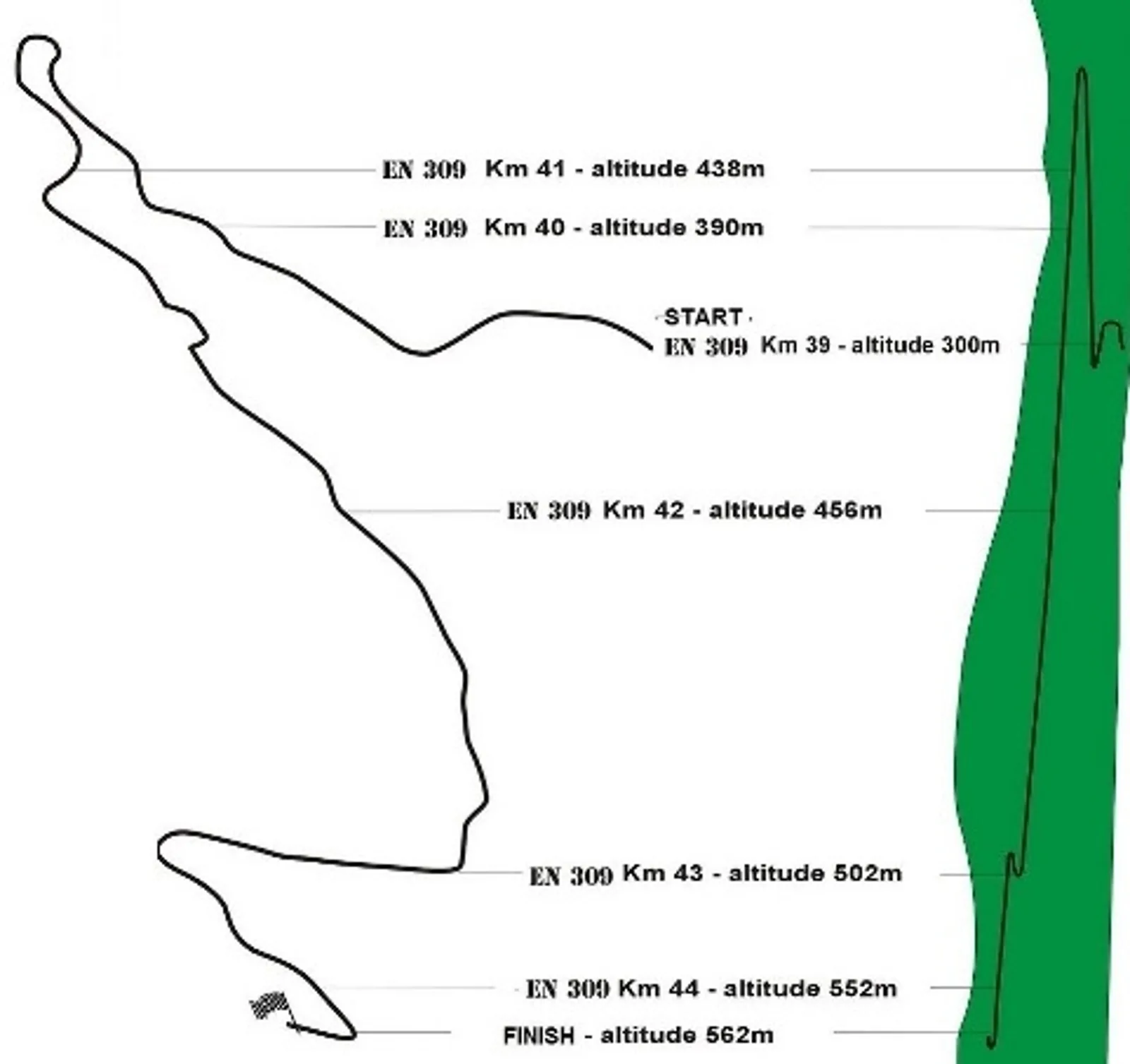
Falperra, in Braga, Portugal, hosts an annual international hill climb to the top of the mountain. The road runs 5.2 km (3.2 mi) and climbs 262 m (860 ft) at an average grade of 5%, starting at km 39 of the EN 309 highway.
It is on the FIA European Hill Climb Championship calendar and also counts towards the Portuguese and Spanish national championships. Held since 1927, it is the most popular hill climb in Portugal, drawing some two hundred thousand spectators per edition. Touring cars, sports cars and single-seaters compete, and there are about 250 entrants on average.
Falperra history
A local commission from Braga promoted the first Falperra Hill Climb in 1927. The Automovel Clube de Portugal organised the second edition in 1930. The competition resumed in 1950, which the club named the Falperra First Hill Climb, and every later edition is counted from that year.
In 1976 the Automovel Clube do Minho took over the organisation and applied for international status, and the FIA brought the event into its European Championship in 1978. Every running since has been on an FIA international calendar, except the first race of 1984, when two were held: one in May for the national championship and one in September for the European Championship.
The 2002 event was the last for years because local authorities could not agree on how to make the track safer. It did not return until 2010, when the improvements were made. In 2013 it was again at risk, but supporters applied pressure on social networks and Braga city hall made the safety changes the FIA had requested that same year. The FIA chose Falperra to host the FIA Hill Climb Masters in 2020, which COVID-19 concerns postponed to 2021, with the track shortened to 2,970 m for the occasion.
The record was set in 2019 by the Italian Christian Merli in an Osella FA 30, with a time of 1:46.944. He beat his own previous record, 1:47.890, which he had set the year before in the same car.
How do Giants Despair, Knox Mountain and Falperra compare?
| Giants Despair | Knox Mountain | Falperra | |
|---|---|---|---|
| Location | Laurel Run, Pennsylvania, USA | Kelowna, British Columbia, Canada | Braga, Portugal |
| First run | 1906 | 1956 (Knox Mountain since 1966) | 1927 |
| Length | 1.6 km (1 mile) | 3.5 km (2.2 mi) | 5.2 km (3.2 mi) |
| Climb | 200 m (650 ft) | 245 m (800 ft) | 262 m (860 ft) |
| Gradient | Up to 20% | Average 6.7% | Average 5% |
| Record | 35.602 sec, Mark Aubele, 2026 | 1:34.903, Aran Cook, 2023 | 1:46.944, Christian Merli, 2019 |
What has changed recently at these hillclimbs?
Knox Mountain added a video wall and a livestream in 2024, and phased in SCCA classifications during the 2020s. Falperra staged the FIA Hill Climb Masters in 2021. In Vermont, the club council meets every year to review and update its rules.