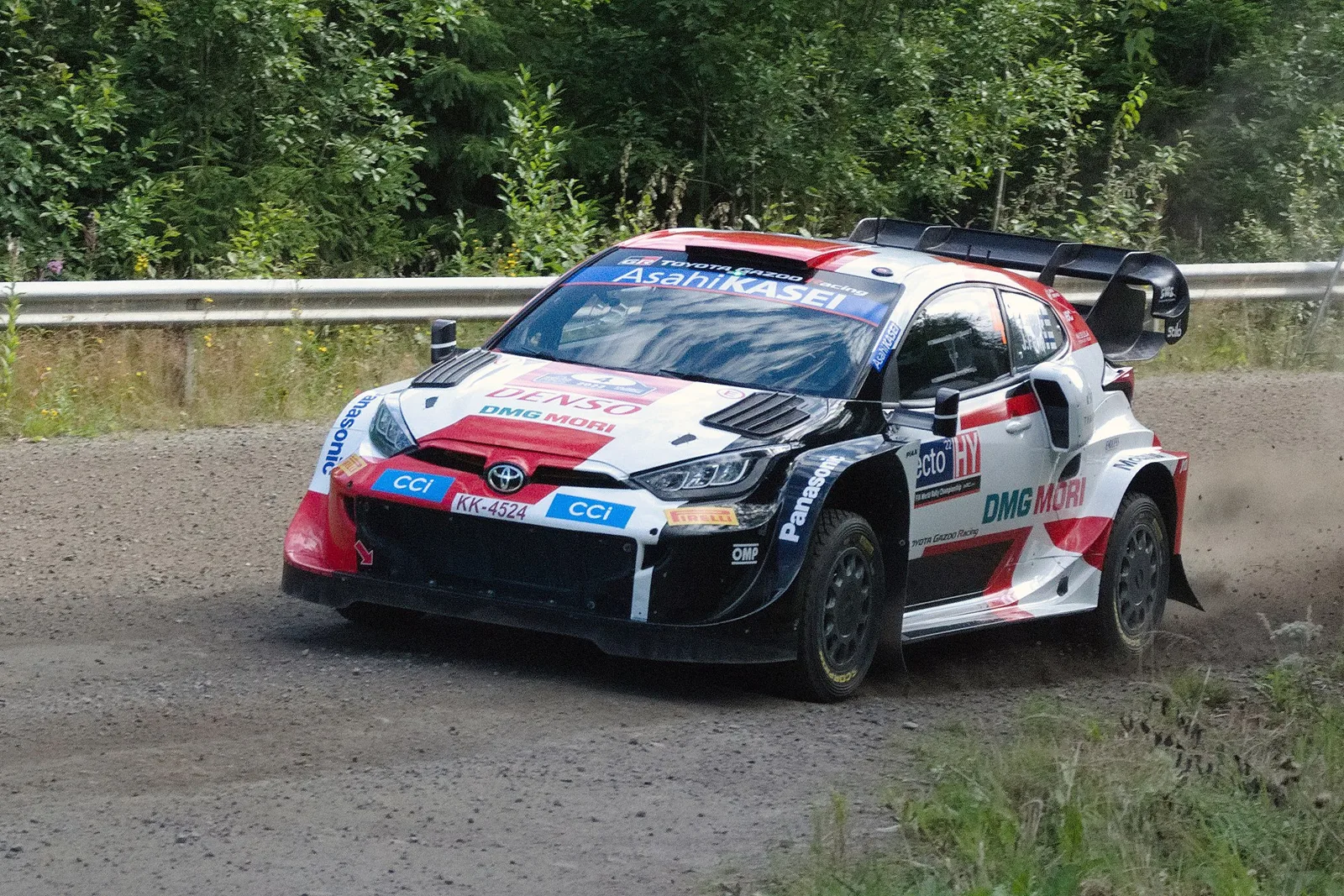
Jumps and blind crests in Finland, a crowd problem that helped end Group B in Portugal, and sandy Sardinian mountain roads: three rounds of the World Rally Championship and where each stands now.
Rally Finland is the fastest round of the World Rally Championship, run on wide gravel roads with jumps. Rally de Portugal is now an all-gravel event, and Rally Italia Sardegna uses narrow, sandy mountain roads. Portugal and Sardegna are not on the WRC calendar for 2027.
Two of the World Rally Championship's best-known rounds are dropping out of its 2027 calendar. The Automovel Club de Portugal said on 29 September 2026 that Rally de Portugal had been excluded, while Rally Italia Sardegna, a WRC round from 2004 to 2026, is set to move to the European Rally Championship. Rally Finland, the third in this trio, remains the championship's fastest event.
Why is Rally Finland called the Grand Prix of Rallying?
Rally Finland, officially Secto Rally Finland and once the 1000 Lakes Rally, is the quickest round on the World Rally Championship calendar. It runs on wide, smooth gravel roads in the Finnish Lakeland, with blind crests and big jumps, and has picked up the nicknames Grand Prix of Rallying and Grand Prix on Gravel. Hundreds of thousands of spectators turn up each year, making it one of the largest public events in the Nordic countries.
Outsiders struggle there. Just eight winners have come from outside Finland and Sweden, and through the 1980s and before, the fields were almost entirely Finnish and Swedish. Walter Rohrl never entered, and Miki Biasion started only twice in a 15-year career.
Rally Finland has been dubbed the Grand Prix of Rallying.
How did Rally Finland begin?
It started as an improvised qualifier for the Monte Carlo Rally. Of thirty Finns who wanted a place on Monte Carlo, only 14 fitted within the quotas set for Finns and Swedes. Selection had been through the Hanko Run in southern Finland, whose rules were far from Monte Carlo's. Pentti Barck's idea of a yearly event in Jyvaskyla won approval in July 1951, and the first rally set off on 1 September 1951 as the Jyvaskylan Suurajot, the Jyvaskyla Grand Prix.
That first event had 26 entrants and a 1,700 km (1,060 mi) route that ran north to Rovaniemi in Lapland by way of Kokkola and Oulu before returning to Jyvaskyla. Arvo Karlsson won in an Austin Atlantic, having gathered the fewest penalty points and stayed closest to target times through the route and the hillclimb and acceleration tests.
Growth was quick. In 1952 Helsinki became an alternative start and the field grew to 48. In 1953 Oulu was added as a third start and 66 crews set off at two-minute intervals over 2,200 km. In 1954 it gained the English-language name Rally of the Thousand Lakes, with eleven starting cities, one of them Sundsvall in Sweden. By 1955 there were eleven special stages, the most of any European rally, and the next year 19 stages covered 1,800 km (1,100 mi).
Erik Carlsson won in 1957 in a Saab 93, the first non-Finn to do so. A year later, in an Alfa Romeo Giulietta TI, the brothers Osmo and Eino Kalpala won for a record third time, which also gave Italian machinery its first victory. Seven drivers crashed out on the same foggy curve that year. In 1959 the rally joined the European Rally Championship, and in 1973 it became a round of the new World Rally Championship.
What made the 1960s and 1970s so intense?
The decade belonged to the first Flying Finns. Rauno Aaltonen won in 1961 and Pauli Toivonen in 1962, when a record 104 drivers started. Simo Lampinen, barely twenty, took consecutive wins in 1963 and 1964. Timo Makinen, in a Mini Cooper S, won in 1965 and 1966, then in 1967 beat Lampinen by eight seconds, even though he tackled the fast Ouninpohja stage with the bonnet open. Hannu Mikkola followed in a Ford Escort TC, and a Castrol film called Flying Finns recorded the duel between the two.
Popularity brought problems. Practice was allowed from 1965 and speeds rose, spectators crowded the road edge and sometimes blocked it, and of 173 entries only 130 were let start. The number of officials rose from 1,200 in 1965 to over 3,000 in 1968, and from 1966 entry was limited to drivers who had finished at least three rallies. Nearly half of 115 starters failed to finish the 26 stages that year.
The 1970 rally had a record 52 stages totalling 460 competitive kilometres, and an estimated 350,000 to 500,000 spectators watched Mikkola match Makinen's three in a row. In 1972 the stages stretched to almost 700 km, and the old Harju hill stage vanished because Jyvaskyla banned racing in the city.
Its place in the 1973 championship was not guaranteed. The 1000 Lakes fought for one of the last three Europe-based spots with the Coupe des Alpes, the Austrian Alpine Rally, Rally Poland and the Rallye de Portugal. The calendar grew to 13 events and only the Coupe des Alpes missed out. Makinen then won a fourth time, a first, and also became the first Finnish winner of a WRC round, ahead of Markku Alen in a Volvo and Leo Kinnunen in a Porsche. About 50 teams from 13 countries entered. Mikkola took a record fifth win in 1975, when Toyota scored the first win for a Japanese manufacturer.
How did the 1980s change Rally Finland?
The 1980 event ran only as a drivers' world championship round, for the first and last time, and was the world's first rally to hand out action and safety instructions. Even so, serious accidents hit the early 1980s: in 1981 an Audi Quattro crashed into five end-of-stage officials, and in 1984 a car hit spectators standing in a forbidden area at the Humalamaki jumps.
Audi dominated in 1982 with Mikkola and Stig Blomqvist, who were told to hold position over the second half. The following year Mikkola edged Blomqvist to reach seven wins, a record that still stands, with a time on the 24.5 km (15.2 mi) Ouninpohja stage of 11:56, 52 seconds quicker than four years earlier. For 1984 organisers planned for more than half a million spectators and named about 5,000 marshals. Vatanen won that year, and Peugeot's Timo Salonen won in 1985 and 1986. In 1985 the drivers' world championship was decided in Finland for the first time, with Salonen taking the title with three rallies left.
Drivers criticised organisers in 1987 for slowing the rally artificially. The route had been modified in 1986 to pull average speeds nearer the 110 km/h ceiling set by FISA, though the organisers had a 10 percent allowance. The 1988 rally drew a record 214 sign-ups, and Prince Albert II of Monaco came to watch. Juha Kankkunen led Markku Alen by two seconds after 33 of 39 stages, then his engine failed, and Alen thereby became the first man to take six wins on one WRC round. Only two Finns finished in the top ten. In 1989 Sweden's Mikael Ericsson became the first non-Finn winner in 18 years.
The 40th anniversary in 1990 took the route to Tampere and drew roughly 450,000 to 500,000 spectators. Toyota's Carlos Sainz became the first winner from outside Finland and Sweden, and Didier Auriol repeated the feat in 1992 ahead of his Lancia teammate Kankkunen, who won in 1993.
What is Rally de Portugal?
Rally de Portugal was first held in 1967. The seventh running, billed as the 7th TAP Rallye de Portugal, counted as round three of the inaugural 1973 World Rally Championship, and it stayed on the calendar for the next 29 years. In the 1970s, 1980s and early 1990s it mixed asphalt and gravel; today it is entirely gravel.
Five times it has been named The Best Rally in the World, and in 2000 it earned Most Improved Rally of the Year. Sebastien Ogier is its most successful driver, with seven wins in 2010, 2011, 2013, 2014, 2017, 2024 and 2025.
How did Portugal's crowds affect Group B?
The rally was hugely popular and also notorious for poor crowd control. In the 1970s and especially the 1980s, spectators stood on the road as cars passed, producing near-misses and, in 1986, an actual collision. That was the last year Group B cars dominated the championship, and the Portuguese accident put their future under scrutiny. Later that year the death of Henri Toivonen at the Tour de Corse delivered the final blow.
The 1986 crash happened on the Lagoa Azul stage in Sintra, when the works Ford RS200 of Joaquim Santos left the road and ploughed into spectators, killing three and injuring dozens. All works teams withdrew. Timo Salonen confessed he feared being first car on the road, and Walter Rohrl advised treating the crowd as a wall. In 1987 a privately entered car plunged into the crowd, killing one spectator and injuring 12. Crowd control did not improve substantially until the early 1990s. Crowd sizes stayed the same, yet spectators behaved better and understood the dangers.
The 1980s edition also included a stage at the Autodromo do Estoril.
Why did Rally de Portugal leave the WRC and come back?
The last WRC edition for five years was run in heavy rain in 2001 and won by Tommi Makinen in a Mitsubishi Lancer Evolution. In 2002 Germany's Rallye Deutschland replaced it. The organisers announced in 2005 that they wanted to rejoin, this time moving to the Algarve, which made the rally fully gravel. Portuguese fans frowned on that, finding the Algarve stages less exciting, and attendance dropped. The event was formally added to the 2007 calendar on 5 July 2006, and Citroen's Sebastien Loeb won that year.
It spent a year in the Intercontinental Rally Challenge and then returned to the WRC for 2009, based around Faro, over twisty hills with fast corners the drivers could not see through. In that event Jari-Matti Latvala took the lead after Henning Solberg won the first stage, then rolled his Ford Focus WRC 17 times on a steep mountainside. Loeb won. From 2015 the rally went back to its roots in the north of Portugal. The 2020 edition was cancelled because of the COVID-19 pandemic.
In May 2025 organisers agreed a three-year deal with WRC Promoter that would secure a place on the calendar through 2028. Then on 29 September 2026 the Automovel Club de Portugal announced it would be left off the 2027 calendar, despite an earlier scheduled date of 13 to 16 May. The decision followed calendar changes meant to increase geographical diversity. Organisers began talks with WRC Promoters about a possible return in 2028.
What is Rally Italia Sardegna?
Rally Italia Sardegna, once called Rally d'Italia Sardegna, is held on the Italian island of Sardinia. It was a WRC round from 2004 to 2026, apart from 2010, when it ran as an Intercontinental Rally Challenge event. From 2027 onwards it is set to be a European Rally Championship event.
The roads are narrow, twisty, sandy and bumpy mountain routes around the town of Alghero or Olbia. Sardegna took over as Italy's WRC round from Rallye Sanremo, which had begun as a mixed surface event and later moved to asphalt roads around the resort of Sanremo.
The 2008 rally ran from 15 to 18 May, and its latest stage, Liscia Ruja at 2.69 km close to a five-star hotel at Cala di Volpe, known as a favourite of James Bond, was broadcast live. The 2010 edition was the first under IRC rules, with four stages shown live by Eurosport.
How do the three rounds compare?
| Rally | Setting | Surface and character | WRC status |
|---|---|---|---|
| Rally Finland | Finnish Lakeland, Central Finland | Wide, smooth gravel with blind crests and big jumps; fastest in the WRC | Finnish round since 1973 |
| Rally de Portugal | Portugal | All gravel today; mixed asphalt and gravel in earlier decades | Third round of 1973; excluded from the 2027 calendar |
| Rally Italia Sardegna | Sardinia, around Alghero or Olbia | Narrow, twisty, sandy and bumpy mountain roads | 2004 to 2026, except 2010; European Rally Championship from 2027 |