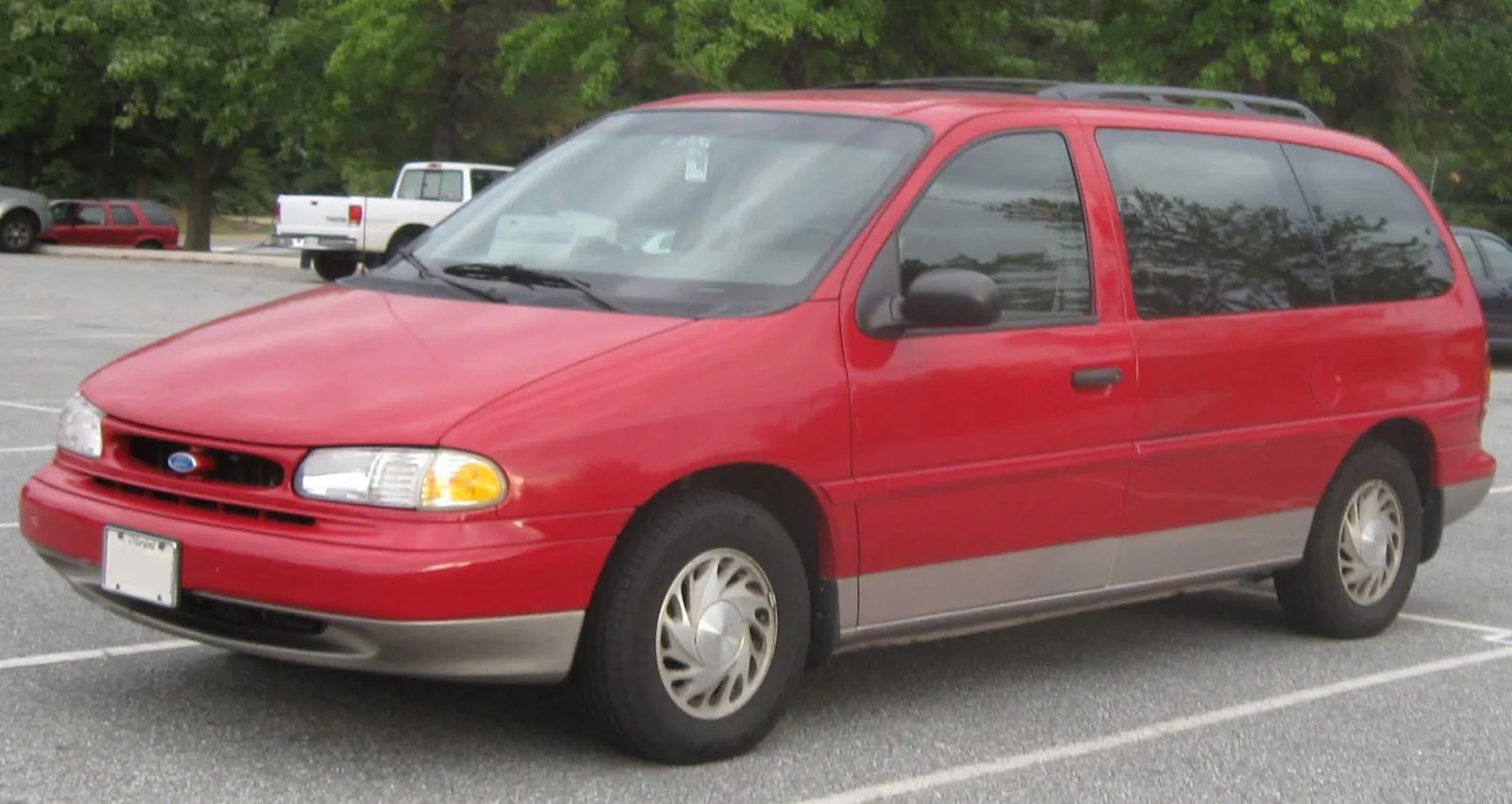
Ford's second minivan, built at Oakville, went from a Chrysler rival with no driver's sliding door to a Freestar with dual sliding doors and a long run of recalls.
Built at Oakville in Ontario from 1995 to 2007, the Ford Windstar was a front-drive minivan that succeeded the Aerostar. Its third generation became the Freestar, and Mercury sold a Monterey twin from 2004 onward, with nearly two million vans built in total.
The Ford Windstar was a front-wheel drive minivan that Ford built from the 1995 to 2007 model years. It was the company's second minivan line, and it went on to become the Freestar in its final generation. Built at Oakville in Ontario, it reached nearly two million units across the Windstar, Freestar and Mercury Monterey versions.
What was the Ford Windstar?
The Windstar was the successor to the Ford Aerostar, and it adopted front-wheel drive and a two-box body in place of the older design. It ran for three generations, and the final one took the Freestar name, with a Mercury Monterey version sold alongside it from 2004.
Unrelated to the Nissan-developed Mercury Villager, the Windstar was sold without a Lincoln-Mercury counterpart at first. Mercury only introduced its own Ford-produced minivan in 2004, when the Monterey name returned.
Ford's second minivan went from a rival built without a driver's sliding door to a Freestar with two sliding doors.
Why did Ford build a front-drive minivan?
The Aerostar had sold reasonably well, but it consistently finished second in the minivan segment behind its rivals. To compete more directly with Chrysler, Ford decided its next minivan would copy the front-wheel drive layout that Chrysler had popularised.
The project was codenamed WIN88 and began in 1988, with a projected introduction for the 1994 model year. The concept theme was settled by December 1989, and the Windstar name was trademarked on April 13, 1992, shortly before development ended.
Who designed the Windstar, and who was it for?
The Windstar was designed predominantly by a women-led engineering and design team. Although the Ford truck division developed it, the car was intended almost entirely for family use, so the team considered design scenarios from a range of perspectives.
The result included family-friendly touches such as reconfigurable cupholders and auxiliary stereo controls. The team also thought about how a car would be used by pregnant women and by drivers wearing skirts and high heels, and those ideas shaped the cabin.
How did the first-generation Windstar launch?
The Windstar was released in March 1994 as a 1995 model, more than a year ahead of the third-generation Chrysler minivans. That gap let Ford take a significant bite out of Chrysler's minivan sales.
The Windstar was sold only as a rival to the long-wheelbase Grand Chrysler vans, while Lincoln-Mercury sold the smaller Mercury Villager. From 1995 to 1997 the Windstar was sold alongside the Aerostar, because continued demand for the older van kept it on sale after its planned end.
In its first year the Windstar was priced above both the Aerostar and the Villager. By 1997 the Villager's base price had passed the Windstar's by several hundred dollars, and the top Villager Nautica was priced some $6,000 higher.
What were the first-generation engines and chassis like?
The first generation rode on the DN5 front-wheel drive platform shared with the first-generation Taurus and Mercury Sable. Its 120.7-inch wheelbase was nearly 15 inches longer than the Taurus, and it used full unibody construction in place of the Aerostar's frame rails.
MacPherson struts handled the front, while a beam axle with coil springs took the rear. Air suspension was an option, and anti-lock brakes were standard. Four-wheel disc brakes arrived as an option in 1996, and they were paired with traction control or the towing package.
At launch the 3.8L V6 was the only engine in the GL and LX, producing 155 hp. A 150 hp 3.0L V6 arrived as the standard engine on base and lower GL models in October 1995, and the 3.8L rose to 200 hp for 1996.
The Windstar was given a longer wheelbase than the Aerostar and the second and third-generation Chrysler minivans. Only the long-wheelbase version was sold, which kept the van consistent with the Chrysler benchmark it was built against.
Why was the first Windstar sold without a driver's sliding door?
The first generation was marketed without a driver-side sliding door, a feature that Chrysler's third-generation minivans had made popular. Ford said its focus groups did not treat the door as important, although vans of every size with a driver-side slider had sold poorly in the United States.
The omission later became a design faux pas, and the 1998 revision tried to fix it. The company extended the driver's door, added an optional tilting and sliding driver seat, and marketed the change as the Family Entry System Door, though Ford also called it the king door.
What did the 1998 revision change?
The 1998 model year came after a shortened 1997 season that ran from October 1996 to January 1997, and the revision coincided with a mid-cycle update. Beyond the king door, the front fascia gained a trapezoidal grille and redesigned headlamps with amber turn signal lenses.
The rear saw mild changes, including new tailgate badging with a larger model script and the Ford Blue Oval centred over the licence plate. The GL and LX and Limited trims received their own bodyside mouldings, and the Limited added five-spoke 16-inch chrome wheels.
The interior saw minor work too. The power vent switches moved to the driver's door, the rear wiper gained an intermittent setting, and head restraints were added to the rear bench seats. A Northwoods appearance package was offered for the GL and LX as well.
What did the second generation bring?
The second generation was released in the summer of 1998 as an early 1999 model. It was a complete redesign that brought the New Edge styling language to the Windstar, along with a driver's side sliding door that the first generation had lacked.
Ford moved the van onto a dedicated chassis architecture, the Ford V platform, while keeping mechanical links to the Taurus and Sable. Front seat-mounted side airbags appeared on some vans, along with dual power-sliding doors and rear reverse sensors.
The second generation changed each year. In 2000 the Limited returned as the most luxurious model, with a VCR-based rear-seat entertainment system. In 2001 the 3.0L was dropped, the 3.8L became the sole engine, and the transmission moved to the 4F50N. In 2002 dual sliding doors became standard.
The last Windstar came off the line on July 25, 2003, with no major changes made in anticipation of the 2004 redesign. The next model was rebranded as the Ford Freestar.
Which trims did the second-generation Windstar offer?
In 1999 Ford began a trim shift that appeared across many of its American sedans. The LX became the base model, while the SE and SEL became the highest trims, and the Limited returned as the top luxury option from 2000.
The LX came with seven-passenger seating, air conditioning, keyless entry and an AM/FM radio with cassette player. The SE added cloth seats and a six-way driver's seat, while the SEL brought automatic headlamps and leather seats. The Limited added a reverse sensing system, side airbags and a premium six-disc CD player.
The SE Sport ran from 2001 to 2002 in the United States, with special wheels, a spoiler, ground effects and a sport front bumper. In Canada the same trim was simply called the Sport and continued until 2003.
Was the Windstar reliable?
No, not in its early years. The 3.8L V6 Essex engine of 1995 models was prone to head gasket failure, and the Windstar's cast iron block with aluminium heads was under more strain than the Taurus, because the van weighed about 700 pounds more. Ford extended the head gasket warranty to 100,000 miles on most vans with that engine.
The AX4S transaxle was another weak point. Its forward and reverse clutch pistons could crack, and the failures were most common with the 3.8L engine, which put extra torque through a transmission that could not cope with the extra weight.
Suspension was also a problem. The heavy van wore tie-rod ends quickly, and in cold, salt-heavy markets the front springs were prone to breaking, which led to a safety recall.
The second generation fared better on the dependability charts. In the 2005 J.D. Power survey, the Windstar was ranked the most dependable minivan at three years in service, beating the Toyota Sienna and the Honda Odyssey.
What recalls affected the Windstar?
In August 2010 Ford issued a voluntary recall of 575,000 Windstars for rear axle problems. The National Highway Traffic Safety Administration had started its investigation in May 2010, and it found that the inverted U-channel beam appeared to trap road slurry, so that corrosion weakened the axle until it fractured in salt-heavy states.
In May 2012 another 27,000 Virginia vans were added to the axle recall, which brought the overall total past 600,000 vehicles in the United States and Canada. A class action followed in May 2010, and Ford's internal documents showed that heat treating could double the life of the axle.
In March 2011 the NHTSA and Ford announced a separate recall of 425,288 Windstar vans from the 1999 to 2003 model years, over corrosion in the subframe. If the subframe collapsed, the driver could lose steering control, so Ford offered alternative transport and agreed to buy back vehicles that could not be repaired.
How safe was the Windstar?
The 1995 to 1998 Windstar received an Excellent rating from the Insurance Institute for Highway Safety in all marks, and Ford marketed it as the safest minivan on the market. Later vans fared less well, and the 1999 to 2003 Windstar earned only an Acceptable rating for fair structural performance.
The NHTSA gave the 1999 to 2003 Windstar five stars in both frontal and side impact tests. The third-generation Freestar scored Good in offset frontal testing, but its side-impact result was Poor without side airbags and only Acceptable with them.
Ford's dependability record also drew praise at times. In 2009 the 2005 Freestar was placed second in J.D. Power's Vehicle Dependability Study, behind the Dodge Caravan.
What changed in the third generation as the Freestar?
The third generation arrived for the 2004 model year as the Ford Freestar, moving away from the New Edge look of its predecessor while keeping much of the roofline. Its styling matched Ford's newer sedans, wagons and SUVs, including the Explorer, Freestyle and Five Hundred.
The interior dropped the curved dashboard of the earlier vans and shared much of its design with the Five Hundred. The third-row seat was redesigned to stow into the floor, and it could fold back to create a rear-facing seat with the liftgate open. The Freestar was the first Ford minivan built solely with dual sliding doors.
The $600 million redesign focused on driveline reliability. It kept the MV1 platform but added heavier-duty drive axles, larger wheel bearings and standard four-wheel disc brakes. The 3.0L and 3.8L V6s were retired in favour of new engines developed from the 3.8L, with a 3.9L as the standard US engine and a 4.2L V6 as the option.
The 4.2L became standard across the range in late 2007, after the 3.9L ceased production. The transmission was also upgraded for better shifting, but transmission failures remained common. The NHTSA opened an investigation into the 2004 and 2005 Freestar and Monterey, and Ford later recalled those vans to replace the torque converter free of charge.
Did Mercury sell a Windstar twin?
Yes, from 2004. The Mercury Monterey replaced the Villager and gave the division its first Ford-produced minivan, taking its name from an earlier Mercury sedan. It was a direct rival to the Chrysler Town and Country, and it also competed with the Buick Terraza and the top trims of the Honda Odyssey and Toyota Sienna.
The Monterey was styled to match other Mercury models, with an interior that echoed the Montego and borrowed wood trim from the Grand Marquis. It was offered in Convenience, Luxury and Premier trims. Premier had heated and cooled front seats, a feature that was unusual in the class at the time.
Monterey sales fell far below projections, driven largely by a decline in the minivan segment. In total 32,195 examples were sold over its three-year run, and the final Monterey left Oakville Assembly on August 25, 2006.
What were the Windstar and Freestar specifications?
The table below lists the main figures across the three generations. Where a value applies to one generation or engine only, the row says so.
| Specification | Detail |
|---|---|
| Model years | 1995 to 2007, with the final generation sold as the Freestar |
| Platform (first generation) | DN5, 120.7-inch wheelbase |
| Platform (second generation) | Ford V platform |
| Platform (third generation) | MV1, shared with the second generation |
| Launch engine (1995) | 3.8L V6, 155 hp; 3.0L V6 at 150 hp from October 1995 |
| Freestar engines | 3.9L (standard US); 4.2L V6 (option, standard late 2007) |
| Redesign cost | $600 million for the third generation |
| Total built | 1,984,232, including 1,704,786 Windstars, 246,493 Freestars and 32,953 Montereys |
| Last built | Windstar on July 25, 2003; Freestar on December 29, 2006 |
What replaced the Windstar and Freestar?
Ford discontinued the Freestar and Monterey after the 2007 model year, without a direct replacement. In North America the Taurus X filled the three-row role from 2008, and the Flex wagon followed for 2009 with four forward-opening doors.
Ford became the first American maker to leave the minivan segment altogether, after 32 years. From 2010 it imported the Transit Connect from Turkey, and the Transit Connect was later sourced from Spain. A long-wheelbase version from 2014 brought seven-passenger seating back to the Ford range.
Outside North America, Ford largely replaced the Freestar with the Transit and Tourneo, and that van was also introduced in Mexico.
Frequently asked questions
How many Windstars were built?
Ford built 1,984,232 vans in total, including 1,704,786 Windstars, 246,493 Freestars and 32,953 Montereys. All of them came from Oakville Assembly in Ontario.
Did the Windstar have a driver's sliding door?
Not at first. The first generation had none, and the 1998 revision added an extended driver's door. The second generation brought a proper driver's side sliding door.
Why was the Windstar recalled in 2010?
Ford recalled 575,000 vans in August 2010 for rear axle problems. The beam trapped road slurry, and corrosion in salt-heavy states could weaken it until it fractured.
Was there a Mercury version of the Windstar?
Yes. The Mercury Monterey was sold from 2004 and replaced the Villager. 32,195 were sold over its three-year run.