How CNG cars work, what a conversion involves, where natural gas vehicles are common and the trade-offs in range, space and emissions.
A CNG car burns methane stored as compressed gas at roughly 200 to 250 bar, either as a dedicated gas vehicle or as a bi-fuel car that can also use petrol. Conversion kits can cost up to 8,000 dollars. Nearly 28 million natural gas vehicles were in use by 2019.
By 2019 there were nearly 28 million natural gas vehicles on the world's roads, yet for years the only one commercially available to US buyers was the Honda Civic GX. That gap explains much of the story of the natural gas car: enormously popular in some places, almost invisible in others, and always a question of where the pipes and the pumps are.
What is a CNG car?
A natural gas vehicle (NGV) runs on compressed natural gas or on liquefied natural gas (LNG). It is different from an autogas car, which burns liquefied petroleum gas (LPG). An NGV burns methane, and the removal of contaminants from the gas source gives it cleaner emissions.
CNG is mostly methane, squeezed to less than 1% of its volume at normal atmospheric pressure. It is kept in high-pressure containers, usually cylinders and occasionally spheres, at roughly 20 to 25 megapascals, or 200 to 250 bar. Because natural gas is lighter than air, it disperses readily if it escapes. Engines come in three layouts: dedicated CNG systems that run only on gas, bi-fuel systems that can use either gas or petrol, and dual-fuel systems that combine CNG with a liquid fuel.
The fuel has served many vehicles beyond cars. Auto rickshaws, pickup trucks, transit and school buses and even trains run on it, and municipal fleets and public transport operators have often adopted it for cost and infrastructure reasons.
Nearly 28 million natural gas vehicles, and still a question of where the pumps are.
Can you convert a car to CNG?
Yes. An existing petrol car can be turned into a dual-fuel petrol and CNG one by an authorised shop. The retrofit adds a cylinder, pipework, an injection system and control electronics. Because engines built for petrol need computer-controlled valves to manage the fuel mixture, which are often proprietary and specific to the manufacturer, this is not a bolt-on job. The cost of a conversion kit can often reach 8,000 dollars on passenger cars and light trucks, so it is usually reserved for vehicles that cover many miles each year. Heavy-duty trucks and buses can be converted too, using spark ignition or hybrid electric configurations.
Factory-built examples are more varied than you might expect. Bi-fuel cars are sold by Fiat, Opel and General Motors, Peugeot, Volkswagen, Toyota, Honda, Maruti Suzuki, Hyundai and Tata Motors, among others. In the US, Ford offers a bi-fuel prep kit as a factory option and lets the customer choose an authorised partner to install the gas equipment. General Motors sends heavy-duty pickups with the 6.0L petrol engine to an upfitter in Indiana. Ram is the only pickup maker whose CNG bi-fuel system is installed at the factory in the US market.
Honda's Civic GX was the only natural gas car on sale in the US for a long time, and it is now discontinued. In 2015 Honda decided to phase out natural gas vehicles and concentrate on hybrids, plug-in cars and fuel cell vehicles. Since 2008 it had sold about 16,000 of them, mainly to taxi and commercial fleets.
Brazil took a different path. General Motors do Brasil introduced the Multipower engine in 2004, able to run on CNG, alcohol or petrol, and used it in the 2005 Chevrolet Astra aimed at taxis. In 2006 Fiat's Brazilian subsidiary launched the Siena Tetra fuel, a four-fuel car with a 1.4-litre engine that could use natural gas, 100% ethanol, the mandatory E20 to E25 petrol blend or pure petrol. It is no longer available in Brazil, but is used in neighbouring countries.
Where the cylinders sit tells you whether a car was built for gas. In a converted car they take up boot space or fill the bed of a pickup. Factory-built CNG models place them under the body and keep the boot free, among them the Fiat Multipla, the new Fiat Panda, the Volkswagen Touran Ecofuel and Caddy Ecofuel, and the Chevy Taxi sold in Peru. Buses typically carry tanks on the roof, though that can need structural changes.
CNG vs petrol: costs, emissions and wear
On price, one account says CNG costs about 50% less than petrol and emits up to 90% fewer emissions. Another puts the CO2 saving at 20 to 29% against diesel and petrol, with lower carbon and particulate emissions per equivalent distance. In one comparison, an engine on petrol covering 100 km produced 22 kg of CO2, against 16.3 kg on CNG. In many markets, especially the Americas, natural gas trades at a discount to petrol and diesel, and many countries also offer tax incentives. Lower operating costs and incentives to cut pollution from heavy vehicles in cities have driven adoption by trucks and buses.
The lifecycle picture needs care. California's Air Resources Board (CARB) gives CNG compressed from pipeline gas a value of 67.70 grams of CO2-equivalent per megajoule, about 28 percent lower than the average petrol in that market at 95.86. CNG from landfill biogas scored 11.26, more than 88 percent lower than conventional petrol. But leaks of natural gas, in use and in production and delivery, add to greenhouse gas emissions, and methane is described as more than 100 times more potent than carbon dioxide at trapping energy. So the benefit depends on where the gas comes from and what it replaces. A 2014 test by the Danish Technological Institute on Euro 6 heavy vehicles found CNG used more fuel than diesel, matched it on noise, CO2 and particulates, but emitted less NOx.
Mechanically, gas is kinder. LNG, and especially CNG, corrodes and wears engine parts less quickly than petrol, so diesel-based NGVs with more than 800,000 km (500,000 miles) are common. CNG does not dilute the crankcase oil, so lubricating oil lasts longer, and the sealed fuel system prevents losses from spills or evaporation. Maintenance costs are described as lower than for other hydrocarbon-fuelled vehicles. Methane has an octane rating of 120 RON, making knock less likely than with petrol.
Safety claims are strong, too. CNG is considered safer than petrol. It ignites at a high temperature, 540 degrees Celsius, and burns only in a narrow flammability range of 5 to 15 percent in air. Despite the lack of harmonised international codes, natural gas vehicles are credited with an excellent global safety record. Relevant standards include ISO 14469-2:2007 for nozzles and receptacles and ISO 15500-9:2012 for the pressure regulator, while NFPA 52 covers natural gas vehicle safety in the United States.
CNG, LNG and LPG compared
| CNG | LNG | LPG (autogas) | |
|---|---|---|---|
| Form | Compressed gas | Cryogenic liquid | Liquid at room temperature under modest pressure |
| Storage | High-pressure cylinders, 210 to 250 bar | Insulated tanks at roughly 5 to 10 bar | Cheaper tanks; far less compression, about 20% of CNG cost |
| Energy density by volume | 9 MJ/L, 42% of LNG and 25% of diesel | 22 MJ/L, more than twice CNG | Higher per weight than natural gas |
| Station economics | Compression is costly; piped gas is common | Utility infrastructure and capital cost favour LNG, but tanker delivery is less common | In the US, Thailand and India, five to ten times more stations than NGV stations |
| Main drawback | Heavy, costly tank; lower range | Extreme cold, special tanks | Volatile and flammable; fumes heavier than air |
Both gases burn in the same basic engine, so with different tanks, fuel metering and computer modules an NG vehicle could run on CNG or LNG without further engine modification. The technologies around them are vastly different, though. LNG needs a vaporiser in the fuel system to turn it back into gas. There are also LCNG stations that store fuel as LNG and vaporise it to CNG on demand, which cost less than fast-fill CNG stations alone but more than LNG stations.
LPG has its own pitch. It is a petroleum-based gas produced from refining, requires far less compression than CNG and needs no chilling. It also burns cleaner than petrol and diesel and wears engines less than petrol does. The drawback is safety: it is volatile and flammable, and its fumes, being heavier than air, collect in low spots after a leak. It has historically cost more than natural gas. In Poland, South Korea and Turkey, LPG stations and cars are widespread while NGVs are not.
What natural gas asks of the car: space, weight and refuelling
Gas needs space. Cylinders for CNG must hold the fuel at 210 to 250 bar and take up more room than petrol or diesel tanks, which can be moulded into intricate shapes. The tank is also more massive and costly than a conventional one, and the combination of weight, size and complexity reduces range. LNG's liquid is more than twice as dense as CNG, so the CNG range is lower.
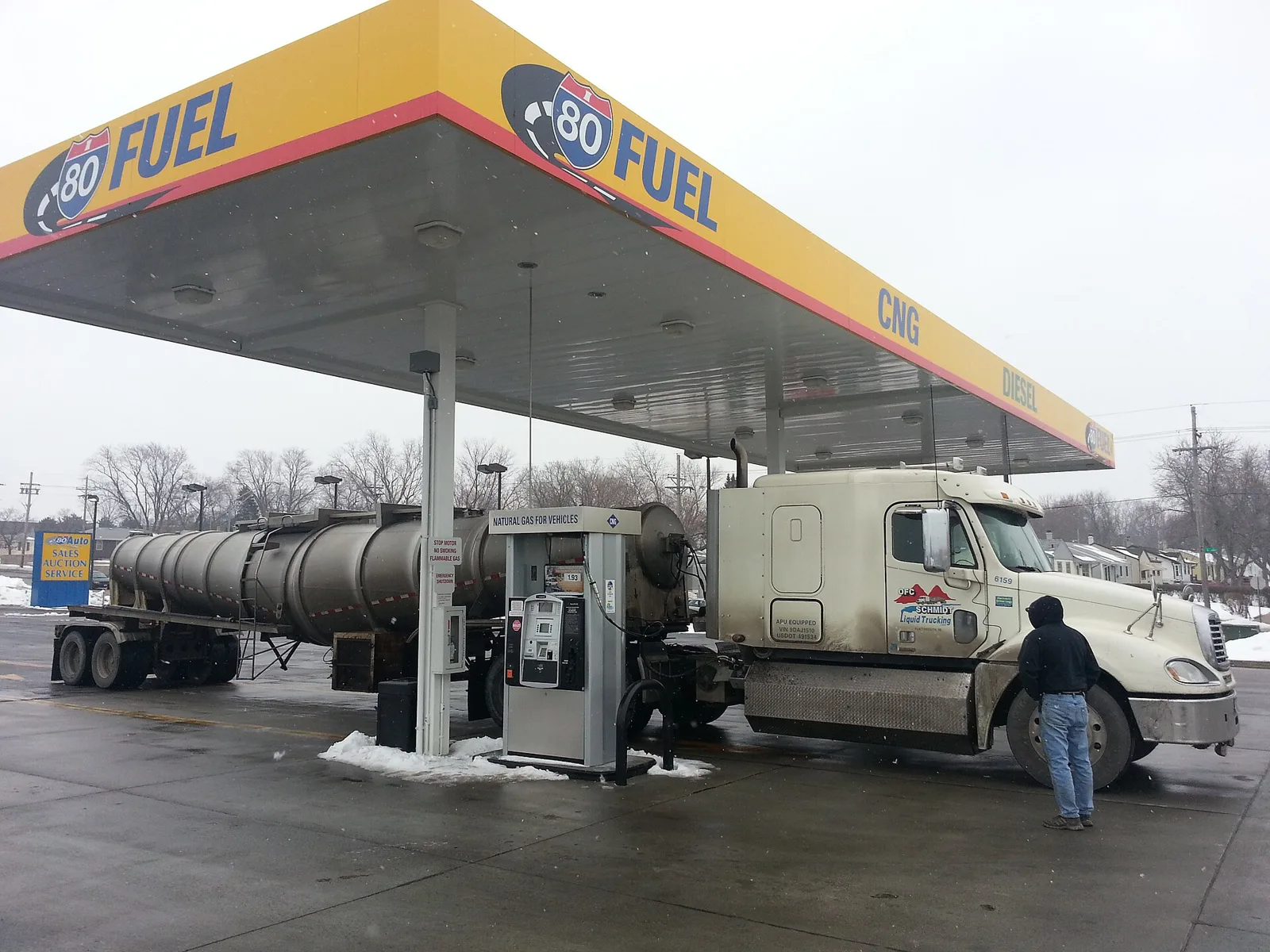
Refuelling depends on where you are. Stations can be built anywhere natural gas lines exist, and small home CNG stations are possible. Home refuellers typically fill at about 1 kg an hour (0.4 gasoline gallon equivalents, or GGE, per hour), whereas at a forecourt, where the pressure is much higher, a 25 kg (10 GGE) tank can be refilled in 5 to 10 minutes. Honda worked with a company called Fuel Maker on a home refuelling appliance for its American Civic GX. The number of refuelling stations worldwide reached 18,202 in 2010, up 10.2% from the year before, but there are still far fewer CNG and LNG stations than petrol and diesel ones.
For private owners the obstacles are extra weight, unfamiliar technology and limited infrastructure in some regions. Other barriers include the cost and reluctance of switching, the prestige and nostalgia attached to petroleum vehicles, and the fact that refiners are set up to produce a certain fuel mix from crude oil.
Where natural gas cars are common
Numbers have grown fast. There were 14.8 million NGVs worldwide by 2011, led by Iran with 4.07 million, Pakistan with 2.85 million, Argentina with 2.07 million, Brazil with 1.7 million and India with 1.1 million. By 2019 the total had reached nearly 28 million, with major presence in China, Iran, India, Pakistan, Argentina, Brazil and Italy. The Asia-Pacific region leads with 6.8 million vehicles, followed by Latin America with 4.2 million, where almost 90% of NGVs are bi-fuel and can switch to petrol. In Pakistan, almost every vehicle converted to alternative fuel, or built for it, keeps the ability to run on petrol.
Market share tells another story. Pakistan's NGV share was 61.1% in 2010, Armenia's was more than 77% in 2014 and Bolivia's was 20%. In the United States, by contrast, the fleet in 2016 was 160,000 natural gas vehicles, 3,176 of them on LNG, and OECD countries together had around 500,000 CNG vehicles. Natural gas buses are popular in India, Australia, Argentina, Germany and Greece.
India shows how regulation can drive a switch. In 1995 its Supreme Court decided that cars put into circulation after that year must run on unleaded fuel. By the start of 2005, 10,300 CNG buses and 20,000 CNG cars were running on Delhi's roads. Other cities now using the fuel include Mumbai, Pune, Kolkata, Lucknow, Kanpur and Varanasi.
In Africa, Egypt is among the top 10 countries for CNG adoption, with 128,754 vehicles and 124 stations. It opened a public CNG station in January 1996, the first in Africa and the Middle East. Nigeria began a pilot in Benin City in 2010, and by June 2020 seven stations served about 7,500 cars. Use is also rising in South America, Europe and North America because of rising petrol prices.
Biomethane, hydrogen blends and other twists
CNG can be mixed with biomethane derived from landfill biogas or anaerobic digestion, which gives mobility with significantly lower carbon emissions than diesel. That would let existing CNG vehicles keep running on the same infrastructure if stricter CO2 rules arrive. Methane today mostly comes from non-renewable sources, but it can be produced from renewable ones.
Researchers are testing adsorbed natural gas (ANG), in which gas is held at 35 bar, the pressure in natural gas pipelines, inside sponge-like materials such as activated carbon and metal-organic frameworks. The stored energy density is similar to or greater than CNG, so vehicles could refuel from the gas network with no extra compression, with slimmer, lighter cylinders. Mixing CNG with hydrogen, known as HCNG, gives a flame speed up to eight times higher. And one proposal suggests a car's CNG tank could double as home energy storage, with the compressor running when renewable electricity is in surplus.
Where this goes next
One of the International Organization for Standardization's technical committees is drafting a standard for vehicle natural gas fuelling stations, which targets the lack of harmonised international codes. Honda's decision to put its resources into electrified cars shows the direction one manufacturer took in 2015.