From Cadillac and ZiL to Royal Claret Daimlers and a Mercedes G-Wagen: the official state car, the British royal fleet and the popemobile compared.
An official state car carries a head of state or government, usually a limousine armoured by the maker or a specialist. The British royal fleet at the Royal Mews follows set liveries and conventions, and the popemobile is a purpose-built papal vehicle, now moving toward an all-electric fleet by 2030 according to the Vatican.
In October 1930, with Britain deep in the Great Depression, King George V and Queen Mary ordered five new Daimler limousines. The stated aim was to stimulate British industry and help unemployment through the winter. A state car, in other words, can be a political statement as well as a vehicle, and few cars make that point as plainly as the ones used by heads of state, royal households and the pope.
Governments pick official state cars for security, capability and stateliness, and increasingly for the national maker behind them. The British royal fleet follows a code of colour, plates and mascots that goes back to Edward VII. The popemobile has evolved from a donated Detroit limousine in 1929 into armoured glass rooms and, most recently, an electric G-Wagen.
What an official state car is
An official state car carries a head of state or head of government on official business, and now and then other ministers or visiting dignitaries. Russia, Germany, Japan, South Korea, the United Kingdom and the United States all ship their own car abroad for state visits. It doubles as a symbol of the leader and the nation, so it must offer enough security, capability and stateliness for the job. A limousine or other luxury vehicle is the usual choice.
Because the passenger is a high security risk, these cars are often heavily modified with armoured reinforcements, either by the manufacturer or by an aftermarket specialist. A motorcade of police or military personnel may surround the car, and the driver may also come from law enforcement or the military. Registration plates vary too: some state cars carry ordinary plates, some special ones and some none at all.
All of them balance two needs that pull in opposite directions: being seen and being safe.
How governments source official state cars
Where a country has its own car industry, the government usually commissions one national maker, or allows several to supply an official fleet. Being chosen is considered an honour for the manufacturer and a sign of the government's confidence in its national industry. The United States president currently uses a Cadillac built by General Motors, with special security features that have not been disclosed. In the past the presidents also used Lincolns from Ford and Chryslers, which meant the Detroit Three were all represented.
Russia shows how politics and industry interact. Soviet leaders used custom-built ZiL limousines. After ZiL declined following the dissolution of the Soviet Union, Russia's presidents moved to the Mercedes-Benz S-Class, but Vladimir Putin later commissioned a new official car from the national automotive establishment, delivered in early 2018. That same year South Korea ordered a heavily adapted Hyundai Nexo SUV.
| Leader | Car |
|---|---|
| President of the United States | Cadillac built by General Motors |
| Emperor of Japan | Toyota Century |
| Prime minister of Italy | Maserati |
| Prime minister of Malaysia | Proton Perdana |
| President of the Czech Republic | Skoda Superb |
| President of Taiwan | BMW 760i Protection |
| British monarch | Bentley |
| Prime minister of India | Land Rover Sentinel high security edition |
| President of South Korea | Hyundai Nexo (from 2018) |
Some countries choose from a pool. The French president can pick cars from Renault or PSA Peugeot Citroen, and Germany's pool includes Mercedes-Benz, BMW and Volkswagen Group. India's prime minister uses a Land Rover because Jaguar and Land Rover are owned by an Indian company, Tata Motors. Countries without major car makers of their own tend to buy from a partner nation with close economic and diplomatic links: Canada generally tries to use only Detroit Three cars, many of them built in Ontario factories, where the three have been making cars since the 1920s. Any such list changes often, as both office holders and vehicles change.
The British royal fleet at the Royal Mews
Britain's state and royal cars live at the Royal Mews at Buckingham Palace, alongside the horse-drawn carriages, and are stored at other royal residences when needed. They fall into five groups: State Cars, Semi-State Cars, State Royal Review Vehicles, support cars, and private vehicles.
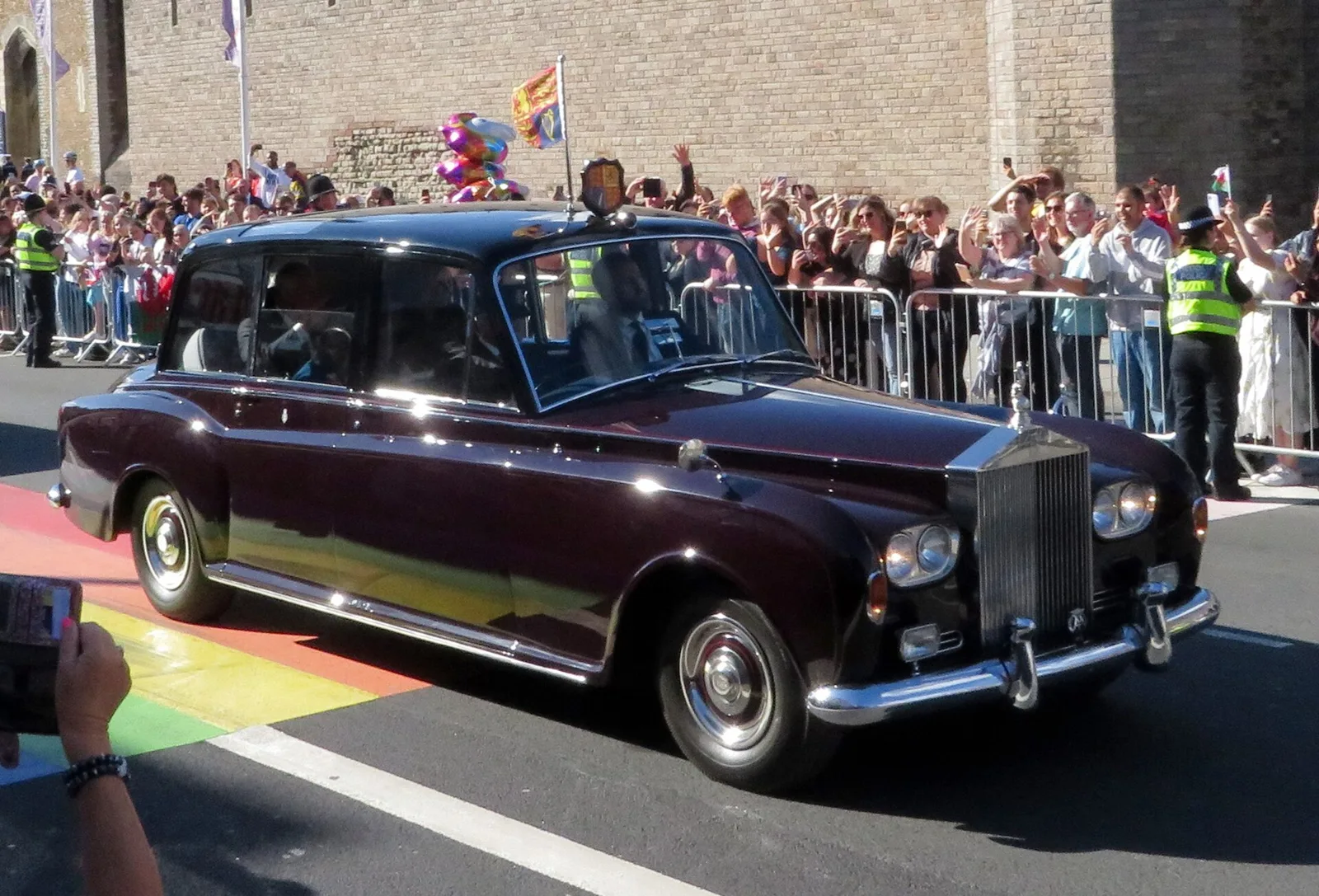
Five State Cars are in service, two Bentleys and three Rolls-Royces, used on ceremonial occasions by the monarch and by those representing the sovereign, and are made available to visiting heads of state. State vehicles go without registration plates, while Semi-State Cars, used for less formal occasions, do show them: two 2012 Jaguar XJ limousines and a trio of 2022 Range Rovers do that job. The State Royal Review Vehicle is a modified 2015 Range Rover Hybrid built to carry standing passengers so that the crowds can see them at parades. A comparatively recent addition is the state hearse, first used in 2022 after the death of Queen Elizabeth II.
All the state and semi-state vehicles share a dual-tone livery that dates from Edward VII's time. Royal Claret, a deep wine colour that looks almost black out of the sun, covers the body below the beltline, and Mason's Black the part above it, with fine vermilion pinstriping. The cars tend to be long-wheelbase limousines with jump seats and a powerful engine, designed to look imposing and dignified. A raised roofline, bright interior lighting and enlarged windows and sunroofs let onlookers see who is inside.
Every State and Semi-State Car has a mount on the bonnet for a mascot. Three are commonly seen: St George and the Dragon for the monarch's car in England, a Lion for Scotland, and Britannia, which was used by George V, George VI, Queen Elizabeth The Queen Mother and later Charles III as Prince of Wales. The roof carries fittings for a shield and flagstaff, displaying the royal coat of arms and Royal Standard when the sovereign is aboard. Since the 1950s the monarch's shields have been back-lit so they glow at night, and a red shield with a crown marks a car carrying another member of the royal family. The cars are numbered, with one and two normally reserved for the monarch, who is always driven by a senior chauffeur, the Head, Deputy Head or Assistant Head, with the Crown Equerry overseeing the department.
The Daimler era and royal motoring
For the first half of the twentieth century Daimler, then Britain's first car manufacturer, was invariably chosen for the monarch's state cars, with bodies from the coachbuilder Hooper & Co., which had held royal warrants for carriage building since 1830. The first royal motorist was Edward VII. As Prince of Wales he took delivery of a 6 hp Daimler in June 1900, with a mail phaeton body by Hooper, and ordered two more Daimlers that year. After becoming king in 1901 he gave Daimler his royal warrant, converted a corner of the Royal Mews into a garage and ordered a 22 hp touring carriage in dark claret.
Horses did not disappear at once. In 1904 the king ruled that electric broughams and motor carriages should not take members of the royal family to Court or State ceremonies. The first time he used a car for an official engagement was 19 October 1904, when a 28-36 hp Daimler limousine drove him to and from Woolwich Garrison. Over the course of the decade he owned ten Daimlers, along with three Mercedes and a Renault for private use.
By the time George V was crowned, the Royal Mews held four cars. The main limousines before the war were two 57 hp straight-six cars seating up to six, in which the king and Queen Mary habitually sat in the middle pair of bucket seats so onlookers could see them. In 1913 the king said that he knew how to drive but never did so in public. By the First World War a set of conventions had emerged, many still in place: claret livery, a royal crest on two or more doors, a personal radiator mascot, the royal arms on a shield or flag from 1911, interior electric lighting, and no registration plates on vehicles used personally by the monarch. George V also stipulated 60 inches of headroom so that a field marshal's plumed hat would fit. From 1923 the king's cars carried a blue light over the driver's canopy to signal his presence at night.
The Daimler partnership deepened. New cars ordered in 1924 had 57 hp straight-six engines. When the Daimler Double-Six V12 appeared in 1926, the king had his State limousines refitted with the new engine the next year. The Depression order of October 1930 brought three limousines, two of which replaced the 1924 State Cars, and two enclosed limousines, one for the queen in green. All five had Daimler's fluid flywheel transmission. In 1934 one of them took the monarch to the State Opening of Parliament because fog ruled out the Gold State Coach. For the Silver Jubilee in April 1935 a bespoke 40/50 hp Double-Six enclosed limousine joined the king's fleet.
The popemobile, from throne to bulletproof glass
The popemobile is a vehicle designed for the pope's public appearances and is the successor to the sedia gestatoria, a portable throne carried on attendants' shoulders. That chair went out of use when Paul VI died in 1978, and John Paul I, who reigned for only 33 days, was the last to use it. The aim is visibility in front of large crowds, and the design varies: open-air or glass-enclosed, seated or standing. The Roman Curia chooses the vehicle each time depending on the level of security needed, the distance and speed involved, and the pope's preferences.
The Vatican's first automobile arrived on 10 November 1929, when the Graham brothers of Detroit's Graham-Paige company donated a Graham-Paige 837 limousine. Pius XI used it on 22 December 1929 to travel to the Lateran Basilica. A Nurburg 460 Pullman given by Mercedes-Benz in 1930, however, is counted as the first official papal car, and Mercedes-Benz has supplied the Vatican most often since. Vatican plates begin with SCV, short for the Latin Status Civitatis Vaticanae, followed by the fleet number; the pope's car has typically carried SCV 1.
The word itself came from the United States. It was first used in English-language media for a custom Lincoln Continental that Paul VI used on a visit to New York in 1965. The car was later sold to an eye doctor in Fort Dodge, Iowa, who marketed it under the name Pope-Mobile and lent it out, including for ticker-tape parades for the Apollo astronauts.
John Paul II used vehicles that changed with every country he visited. In Poland in 1979 it was a white truck-based Star 660, in Ireland a Ford D series truck adapted by the coachbuilder OBAM, and in Germany a converted Mercedes-Benz 230 G. After the attempted assassination in 1981 his car received bulletproof glass. British Leyland provided armoured lorry- and Range Rover-based vehicles for the 1982 visit to the United Kingdom, and one of the Leyland T45 vehicles fetched 37,000 pounds at auction in 2006. In Spain a car derived from the SEAT Panda had a grab handle in front so the pope could stand while moving, and he drove into Barcelona's Camp Nou on 17 November 1982 celebrating Mass before more than 121,000 people. A modified GMC Sierra rebuilt by Thibault Fire Engines in Quebec served in Canada in 1984. For the 1987 United States visit two Mercedes-Benz 230 G models were flown to Washington and altered by the Secret Service to open a way through to the papal compartment from the driver's cab. In 2002 John Paul II asked the media to stop using the word popemobile, calling it undignified.
Abroad, Benedict XVI mostly travelled in a converted Mercedes-Benz M-Class with a glass-enclosed room in the rear and its own oxygen supply. He entered through a rear door and climbed steps to a white leather chair with gold trim, raised by a hydraulic lift for better visibility. Besides the driver there was room for one passenger in front and two aides in the back. The windows and skylights were bulletproof and the body was reinforced armour plating built to withstand explosives, at a cost of about 345,000 pounds at 2011 prices. In 2007 a man jumped a barrier in St. Peter's Square and grabbed hold of the white Fiat carrying Benedict as he began a general audience. The Pope was unhurt, and at least eight security officers brought the man down.
Francis showed a preference for simpler cars. The night he was elected, he rode back with the other cardinals in a minibus, and within Vatican City a small Ford Focus served him, and he also drove himself in a 1984 Renault 4 given to him by an Italian priest. Abroad he used a Kia Soul in South Korea in 2014, a Fiat 500L in the United States in 2015, a converted jeepney and an Isuzu D-Max in the Philippines, a Dacia Duster in Romania in 2019, a Pindad Maung MV3 Tangguh in Indonesia in 2024 and a Hyundai Ioniq 5 in Singapore. In December 2024 he was given an all-electric Mercedes-Benz G-Wagen, the Vatican's first electric vehicle. For his funeral in April 2025, a vehicle based on the Ram 1500 carried his coffin to the Basilica of Santa Maria Maggiore. Leo XIV made his first ride in an open-topped vehicle before his inauguration on 18 May 2025, blessing the crowds in St. Peter's Square.
Where this goes next
The Vatican has said it plans to make all vehicles used to transport the pope electric by 2030. The G-Wagen received in December 2024 was its first. The British Royal Mews, for its part, now runs recent Range Rovers alongside its Bentleys and Rolls-Royces, which shows how the fleet has been refreshed since the Daimler years.
What these cars have in common
All of them balance two needs that pull in opposite directions: being seen and being safe. Royal limousines have a raised roofline, bright interior lighting and large windows so that onlookers can see the passenger. Popemobiles were open-air until the 1981 shooting led to bulletproof glass, while an enclosed room with its own oxygen supply and hydraulic lift lets the pope sit raised above the crowd. State cars for presidents and prime ministers add armour, special security features and a motorcade. The choice of maker, in turn, is part of the message, from Cadillac and the Toyota Century to the Bentleys and Rolls-Royces in the Royal Mews.