A front-wheel-drive hatchback formula, a 650 hp silhouette racer and a series for saloons of at least 3.8 litres, each with its own idea of cost and spectacle.
TCR is a 2014 rulebook for front-wheel-drive production saloons with turbocharged engines up to 2.0 litres. Class 1 covers two generations of silhouette racers, while the Superstars Series ran big production saloons of at least 3800 cc from 2004 to 2013. Each balances cost, spectacle and manufacturer interest differently.
A TCR car and a second-generation Class 1 car both carry a two-litre turbocharged four-cylinder engine, and that is nearly where the resemblance ends. One is a front-wheel-drive saloon or hatchback wearing a reinforced production body, with power set at 355 PS (350.1 HP). The other is a purpose-built, rear-wheel-drive racer capped at 650 hp. Add a third rulebook, the Superstars Series, which put 3800 cc production saloons on the grid, and you have three very different answers to the same question: how do you make touring cars exciting without bankrupting the people who build them?
What is a TCR touring car?
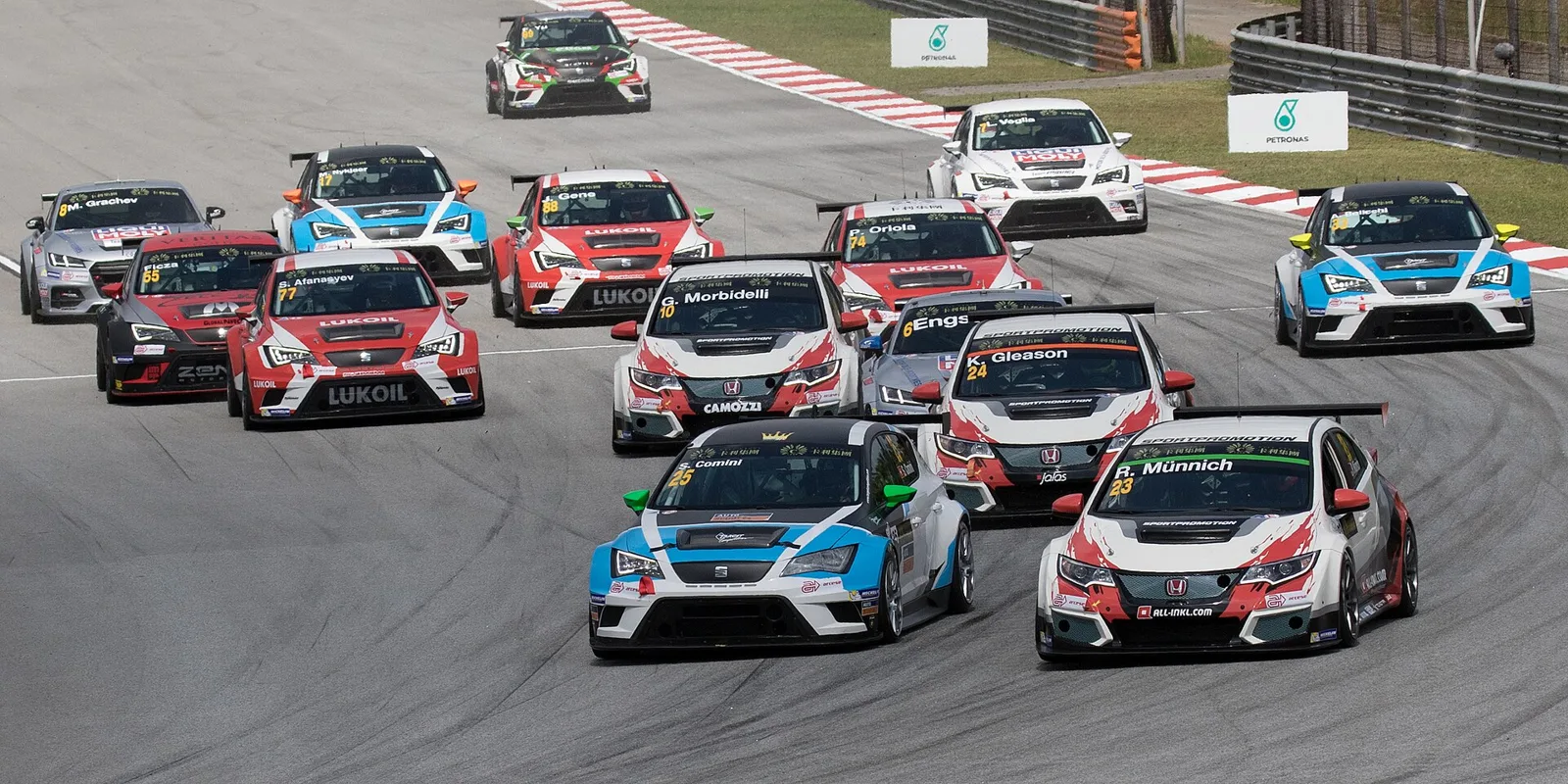
TCR is a touring car specification that arrived in 2014, the work of the WSC Group under Marcello Lotti, who had earlier managed the World Touring Car Championship. The rules were meant to travel well, and they have. Every TCR car is front-wheel drive and starts life as a four- or five-door production vehicle, with a turbocharged engine of 1.75 to 2.0 litres. The bodyshell and the suspension layout stay as they were on the road car, and many models keep their production gearbox. Racing needs only a few changes, such as better brakes and aerodynamics.
Every TCR shares one ancestor, the SEAT Leon Cup Racer, itself the successor to the SEAT Leon Supercopa used in several single-make series. The two-litre engine formula, the standard front splitter and the rear wing all trace to that car. The category was first called TC3, a name that placed it at the bottom rung of the touring car ladder, but after the FIA approved it in December 2014 it became TCR.
Technical regulations were announced on 15 September 2014, with minor changes on 22 January 2016. The minimum weight is 1250 kg with a production gearbox and 1285 kg with a racing gearbox, both including the driver. Cars must be at least 4.2 metres long and no wider than 1.95 metres. Torque is capped at 420 Nm (310 lb ft) and power at 355 PS (350.1 HP). Brakes allow up to six-piston front calipers, rims are limited to 10 x 18 inches, and ground clearance must be at least 80 mm. A homologated catalytic converter from production parts is required, and the engine uses a wet sump.
Because the cars come from different manufacturers, a balance of performance system keeps them close. Power-to-weight is adjusted by adding or removing weight, anywhere between 70 kg more and 20 kg less than the minimum. The FIA also licensed the rules as WTCR for the World Touring Car Cup. The specification was identical but frozen until the end of 2019, and cars needed an FIA passport after TCR homologation.
Since 2017, TCR's organisers, World Sporting Consulting, have given a Model of the Year award to the most successful car. It uses a points system covering all TCR-certified cars in all sanctioned races, with coefficients that reflect the level of competition, the number of cars and the number of manufacturers.
| Rulebook | Years | Engine | Drive and body | Notable limit |
|---|---|---|---|---|
| TCR | 2014 onward | Turbo petrol or diesel up to 2 litres | Front-wheel drive, four- or five-door production shell | 355 PS (350.1 HP); minimum weight 1250 kg |
| Class 1, first generation | 1993 to 1996 | Production-derived, maximum six cylinders and 2.5 litres | Production-based; all-wheel drive allowed | Four valves per cylinder |
| Class 1, second generation | 2019 onward | Two-litre turbo inline-four | Purpose-built, two-door, rear-wheel drive | 650 hp cap; 1,070 kg in the DTM |
| Superstars | 2004 to 2013 | Six to twelve cylinders, at least 3800 cc | Production saloons, four or two doors | H-pattern or mechanical sequential gearbox |
When Alfa Romeo and Opel left the ITC at the end of 1996, the class effectively ended.
Where is the TCR series raced?
The formula is used as the top class in international series such as the TCR World Tour and the FIA Motorsport Games, in regional championships like TCR Europe, TCR Asia and TCR South America, and in national series from TCR UK and TCR Spain to TCR Brazil and TCR Mexico. It also runs as a subsidiary class in events such as the 24H Series, Britcar, the Michelin Pilot Challenge and the Super Taikyu Series. The Scandinavian Touring Car Championship, which uses TCR, is paused, with planning under way for a 2026/27 season.
The roll of defunct series is long too, including the TCR International Series, TCR Australia, TCR USA, TCR Japan, the World Touring Car Championship and the eTouring Car World Cup. A formula this widely adopted has had plenty of local series come and go.
Class 1 touring cars: two goes at the silhouette idea
Class 1 is the name the FIA gave to two separate generations of silhouette-style touring car rules, in which a prototype racer wears the outline of a road car. The first, from 1993 to 1996, was introduced alongside Class 2, which officially became Super Touring in 1995. Class 1 permitted far more liberal modifications than Class 2. Engines were limited to six cylinders, 2.5 litres and four valves per cylinder. Each had to begin as a production engine from the same maker as the car, though not necessarily from the same model, and heavy modification was allowed. Teams could also use all-wheel drive, traction control, ABS and electronic differentials, and from 1995 they could fit purpose-built suspension.
These cars raced in the DTM from 1993 to 1995, the International Touring Car Series in 1995 and the International Touring Car Championship in 1996. Only three manufacturers took part with proper works efforts: Alfa Romeo, Mercedes-Benz and Opel. Audi and BMW both built cars for the class, based on the B4 80 Quattro and the E36 M3, but never raced them. When Alfa Romeo and Opel left the ITC at the end of 1996, the class effectively ended.
The second generation came out of a co-operation agreement between the DTM and Japan's Super GT in early 2014. By September that year they had an official tie-up, and the DTM planned to switch to 2.0-litre four-cylinder engines by 2017. Aerodynamic changes were agreed in 2015, with joint races in prospect. Then manufacturers in the DTM balked at the cost of more development, so the changes slipped to 2019, with Super GT following in 2020, since the final regulations were approved only in 2018.
The result is a purpose-built racer modelled on a two-door road car, although Super GT later made an exception for the Honda Civic. Power comes from a front-mounted two-litre turbocharged inline-four capped at 650 hp, driving the rear wheels through a six-speed paddle-shift gearbox. DTM cars have push-to-pass and DRS, though Super GT cars do not, and they generate 3.4t of downforce. The turbo runs 3.5 bar (51 psi) of boost, fuel is delivered by direct injection, and traction control, active suspension and anti-lock brakes are banned. In 2019 the DTM listed 610 hp plus 30 hp of push-to-pass, changing to 580 plus 60 in 2020, while Super GT GT500 cars are quoted at 550 to 650 PS. Weight is 1,070 kg (2,359 lb) in the DTM and 1,020 kg (2,249 lb) in Super GT, driver and fuel included.
The first Class 1 cars appeared at Hockenheim in 2019, and DTM and Super GT held joint races at the end of that year, although Super GT entered its previous-generation GT500 cars. Then the manufacturers drifted away. Aston Martin entered the DTM through the new rules and quit after a single season, with its constructor R-Motorsport saying the cars were too expensive. In April 2020 Audi announced it would leave for 2021. After just two seasons the DTM dropped the regulations and moved to a formula built on GT3 cars from 2021. That left Super GT as the one series still running Class 1 rules, for its GT500 cars. Its GT300 class continues to use Group GT3 rules.
The Superstars Series: big saloons, sprint races
The Superstars International Series, a touring car championship for cars based on production saloons, ran from 2004 to 2013. Superstars World of Racing SpA, part of Rome's FG Group, managed it, with the Automobile Club d'Italia and the CSAI as sanctioning bodies. FG Group's boss, Maurizio Flammini, had promoted the Superbike World Championship from the start in 1988 until it was sold in 2007.
It began in 2004 as the Trofeo Nazionale Superstars with six races, all at Italian circuits, and a starting field of BMW M5s and Jaguar S-Types run by five teams. From 2005 it became the Italian Superstars Championship and quickly turned into the country's main tin-top racing series, taking the place of the Italian Superturismo Championship, which folded in 2007. That year the series began visiting other European countries after the FIA approved an International Superstars Series, and from then on two drivers' titles were awarded each year, an International one and an Italian one.
A GT support series arrived in 2010, the International GTSprint Series, which allowed GT2, GT3 and national GT cars and used two 25-minute sprint races each weekend. The main series had settled on two sprint races, one on Sunday morning and one in the afternoon, from 2009. By 2012 it was drawing crowds, 33,000 of them at Vallelunga near Rome on 7 October. Johan Kristoffersson took the title in a KMS Audi RS5 after a season-long fight with Vitantonio Liuzzi in a CAAL Racing Mercedes AMG C63, and the success helped his career.
The 2013 rules show the philosophy. The cars had to be production-based saloons with petrol engines of six to twelve cylinders and at least 3800 cc, forced induction allowed only if it was used in the production car, and Wankel engines were not permitted. Gearboxes had to be a production H-pattern or an approved mechanical sequential unit, with automatic and semi-automatic transmissions forbidden. Cars had two or four doors and were homologated for at least four passengers. The idea was to put the biggest touring cars into evenly matched racing, holding down costs, keeping the show lively and restricting driver aids. Ten brands were represented in 2013, among them Audi, BMW, Cadillac, Chevrolet, Chrysler, Jaguar, Lexus, Maserati, Mercedes and Porsche. The Chevrolet Lumina CR8 was a badge-engineered HSV Clubsport R8.
Television pushed the series further. In 2012 it was shown live and as-live in 103 countries, with distribution reaching 195 territories, and the TV media value that year came to 56 million euros. It also reached video games: Superstars V8 Racing in 2009, featuring the 2008 season, and a sequel, Superstars V8 Next Challenge, in February 2010.
The end came in late 2013 when the promoter SWR shut down. The competition was re-branded as the EuroV8 Series, organised by FG Group and ATT, with its new identity revealed at the Autosport International show in January 2014. A separate plan to run a SuperTouringSeries through Pan Asia Racing Enterprise in 2015 was cancelled.
What these rulebooks mean for fans and drivers
TCR's strength is that its cars stay close to what people buy. They keep the production bodyshell and suspension layout, and many keep the production gearbox, so a fan watching a TCR race is seeing a modified version of an ordinary four- or five-door car. Class 1 and Superstars sit at opposite ends. The former is a custom-built racer with a road-car silhouette, expensive enough that Aston Martin left after a season, while Superstars offered the largest engines in the group and a cost-limiting philosophy.
Which of the three rulebooks survive
The Class 1 rules survive in Super GT's GT500 class alone, now that the DTM has moved to GT3-based regulations. TCR continues across international, regional and national series, with the TCR Model of the Year award tracking the most successful car each season. Superstars is finished, having become the EuroV8 Series in 2014.