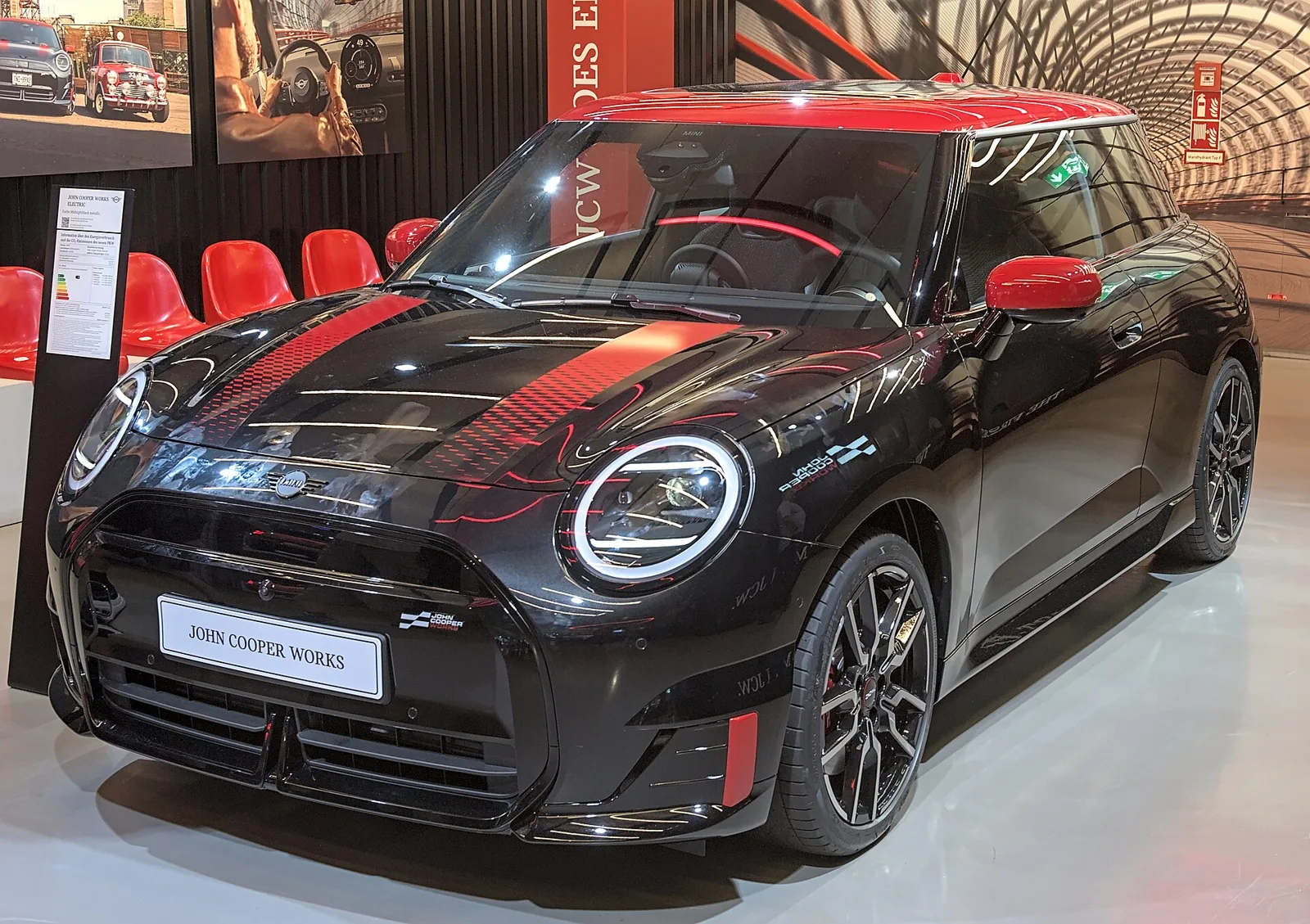
From the 2001 launch under BMW to the electric Cooper of 2023, the Mini Hatch has moved from retro novelty to premium hatchback.
A retro-styled supermini from BMW's Mini brand, built since April 2001 as a three-door, convertible and later five-door. Its fourth generation arrived in 2023 as an electric model, with petrol cars following in 2024. The electric version is built in China, and the petrol cars come from Oxford.
The Mini Hatch is the modern supermini that BMW launched under the Mini name, and it has now passed through four generations. It began as a retro-styled three-door, gained a convertible in 2004, and later picked up a five-door body from the third generation onwards.
What is the Mini Hatch?
The Mini Hatch is BMW's retro-styled supermini, made since April 2001 with a transverse front-mounted engine and front-wheel drive. It has been sold as a three-door hatch, a convertible and, from the third generation, a five-door. The fourth generation arrived in 2023 as an electric hatch, with a petrol version following in 2024.
The name reflects a brand revival rather than a fresh start. The car was developed by Rover Group and BMW, and BMW kept the Mini rights when it sold the rest of Rover in 2000.
A retro supermini that BMW reinvented from 2001, with sporty Cooper engines, limited editions and a rocky quality record.
How did the Mini Hatch begin?
The Rover Group, then owned by BMW, first showed the Mini hatch concept at the 1997 Frankfurt Motor Show. BMW later took control of the whole project in 1999, and the production car started building on 26 April 2001, with showroom sales that July.
Development ran from 1995 to 2001, with Rover working in Gaydon and BMW in Munich. The two teams disagreed about the car's purpose. Rover wanted a straightforward economy car that could replace the Rover 100 Series, while BMW favoured a small, sporting car.
Earlier plans for a new supermini to succeed the Metro had been put aside after BMW bought Rover in January 1994. The existing Metro gained a restyle and a new name instead.
One design story is well known. Frank Stephenson's team had finished a full-size clay mock-up, but he noticed it had no exhaust pipe. He solved the problem in minutes with an empty beer can pushed into the clay at the rear. The board liked the result so much that the tip stayed in production.
What was the first-generation Mini Hatch like?
The first-generation car arrived in July 2001 as the first Mini-branded model since the original was discontinued in 2000. Naturally aspirated Cooper hatchbacks carried the R50 code, the supercharged Cooper S was the R53, and the R52 convertible was built from 2004 to 2008.
Size grew noticeably. The 2001 hatchback measured 3.63 m (143 in), a gain of 58 cm (22.8 in), or 19%, over the 1959 car, which was 3.05 m (10.0 ft) long. The 2002 five-door reached 3.98 m (157 in).
Trim levels separated the range. The Cooper S had a bonnet scoop and twin exhausts, the non-S Cooper had more chrome than the One, and the One D diesel had no visible exhaust pipes. In the US and Australia only the Cooper and Cooper S were sold.
The first generation was facelifted in July 2004, when the convertible also arrived. Minor design changes and better equipment came along, and the Rover R65 manual gave way to a Getrag five-speed for the One and Cooper.
Which engines did the first generation use?
Most first-generation Minis used a Tritec four-cylinder co-developed by Chrysler and BMW, and the One D ran a Toyota diesel. The One used a 1.4-litre unit in some European markets, while other petrol cars used the 1.6-litre version. Engine output varied with the trim, from the base One up to the supercharged Cooper S.
Gearboxes included a continuously variable unit from ZF, a Rover-derived five-speed manual for the 2002 to 2004 models, and a Getrag five-speed after that. The Cooper S offered a six-speed Getrag manual or an Aisin automatic with paddle shifters.
The supercharged Cooper S needed its battery moved to the rear, which left no room for a spare tyre. Those cars therefore came with run-flat tyres, and all Minis were fitted with BMW Cornering Brake Control.
What changed with the second generation?
BMW launched the second generation in November 2006, building it on a re-engineered platform with a Prince engine shared with PSA Peugeot Citroen, built at the Hams Hall plant in Warwickshire. Length rose 60 mm (2.4 in) to meet pedestrian impact rules, and the bonnet was raised.
The range began with the Cooper and Cooper S, the One arrived in 2007, and the economical First followed in 2009. Diesels appeared with the Cooper D in April 2007, the One D in 2010 and the 2.0-litre Cooper SD in January 2011.
The convertible was unveiled at Detroit and Geneva as a 2009 model. It carried an Openometer that logged how many minutes the roof had spent folded down.
The 2010 facelift, which Mini called the Life Cycle Impulse, updated the front bumper, foglights, rear bumper and tail lamps. The interior received softer materials to give a less brittle feel.
How did the second-generation engines perform?
The Cooper's 1.6-litre Prince engine made 120 PS (88 kW) and used Valvetronic variable valve lift. The Cooper S turned to a 175 PS (129 kW) turbocharged engine, which cut the sprint time and added an overboost function on top. Both cars were offered with either a six-speed manual or an automatic gearbox.
Reported figures put the Cooper at 8.5 seconds for 0-60 mph, with a claimed 9.1 seconds for 0-100 km/h. Its top speed is put at 201 km/h (125 mph). The Cooper S was claimed at 7.1 seconds for 0-100 km/h, reaching 230 km/h (140 mph).
The Cooper S gained a twin-scroll turbocharger and petrol direct injection, and its overboost temporarily added 20 Nm (15 lbf-ft) under hard acceleration. Hill Assist held the brakes for 2 seconds on a hill, and from September 2008 DSC was fitted as standard on every Mini.
Diesel models moved to 2.0-litre engines in 2011. The Cooper SD produced 145 PS (107 kW), and its torque peaked between 1,750 and 2,700 rpm at 305 Nm (225 lbf-ft).
Mini Hatch specifications
The table below lists the main outputs and performance claims across the generations. Each row names the model and generation, so the second-generation Cooper and the John Cooper Works cars stay separate.
| Model | Output | Performance claim |
|---|---|---|
| Cooper, second generation | 88 kW (120 PS), 1.6-litre Prince | 0-100 km/h in 9.1 seconds; 201 km/h (125 mph) |
| Cooper S, second generation | 129 kW (175 PS), turbocharged | 0-100 km/h in 7.1 seconds; 230 km/h (140 mph) |
| Cooper SD, 2011 | 107 kW (145 PS); 305 Nm (225 lbf-ft) | Peak torque between 1,750 and 2,700 rpm |
| JCW Challenge race car | 6,000 rpm: 155 kW (211 PS; 208 hp) | 100 km/h (62 mph) in a claimed 6.1 seconds |
| JCW Hardtop road car | 211 PS (155 kW; 208 hp); 261 Nm (193 lb-ft) | 60 mph (97 km/h) in 6.2 seconds |
| GP, 2006 | 7,100 rpm: 160 kW (218 PS; 215 bhp) | 250 Nm (184 lb-ft) at 4,600 rpm |
| GP, 2012-2014 | 6,000 rpm: 160 kW (218 PS; 215 bhp) | 280 Nm (207 lbf-ft) |
| JCW GP, third generation | 225 kW (302 hp); 450 Nm (332 lb-ft) | 0-100 km/h in 5.2 seconds; 265 km/h (165 mph) |
| Cooper C, fourth generation | 115 kW (156 PS; 154 hp); 230 Nm (170 lb-ft) | 1.5-litre three-cylinder turbo |
| Cooper S, fourth generation | 150 kW (204 PS; 201 hp); 300 Nm (221 lb-ft) | 2.0-litre four-cylinder turbo |
What did the 2006 John Cooper Works GP offer?
The John Cooper Works GP Kit was a limited, lightweight Cooper S built in 2006. Only 2000 cars were planned, and 459 were eventually sold. It had bolstered Recaro front seats, no rear seats, and it weighed about 40 kg (88 lb) less than a Cooper S.
Bertone in Italy hand-finished the GP. It had a less restrictive intercooler, recalibrated engine management, larger injectors and a freer exhaust, which together produced a peak of 218 PS (215 bhp; 160 kW) at 7,100 rpm.
Of the planned run, 444 were intended for the UK market, while the final tally reached 459 sold.
Which limited editions did Mini sell?
Mini produced many limited editions, starting with the Mini Monte Carlo tribute and continuing through Goodwood, London street names and anniversary models. Each had special paint, trim or badging, and several were restricted to particular engine ranges. Some were sold only in certain countries, which kept supply tight.
The Mini Inspired by Goodwood arrived in 2012 with Rolls-Royce input, Diamond Black paint and Burr Walnut trim. It produced 184 PS (135 kW) against the regular Cooper S's 174 PS (128 kW), and it was the only special edition based on the Cooper S without a bonnet scoop. It sold new at GBP 41,000 ($52,000).
The 50th anniversary of the original Mini in 2009 brought the Mini 50 Camden and Mayfair. The Camden had White Silver paint and Mission Control, a feature in which three characters spoke to the occupants, while the Mayfair came in Hot Chocolate paint with Toffee stripes.
London street names gave the Baker Street, Bayswater and Green Park editions their titles, with the Earl Grey added in Europe and the UK. Each had its own paint and interior scheme, and some were offered on only one model.
The World Championship 50 of 2009 marked the 1959 victories of Jack Brabham and Cooper. Production was first planned at 250 cars and later raised to 500, including 100 units for the UK and 50 for the US.
The 2012 London Olympic Cooper had a white roof, the London skyline on the dash and a Union Jack on the seats. Only 2012 units were made, all for the UK.
How did the third generation change the Mini Hatch?
BMW unveiled the third generation in November 2013, and showroom sales began during the first half of 2014. It grew 98 mm in length, 44 mm in width and 7 mm in height, and its boot reached 211 litres. It rode on BMW's UKL platform, which also underpins the 2 Series Active Tourer.
The new car was larger in every direction. Track width increased by 42 mm at the front and 34 mm at the rear, and the wheelbase grew by 28 mm.
Six all-new engines were offered, four petrol and two diesel. The petrols were 1.2-litre three-cylinder units with 75 or 102 PS, a 1.5-litre three-cylinder with 136 PS, and a 2.0-litre four-cylinder with 192 PS for the Cooper S. The diesels were a 1.5-litre with 95 or 116 PS, and a 2.0-litre producing 170 PS for the Cooper SD.
The five-door, codenamed F55, arrived as a separate model. It is 152 mm (6 in) longer and 86.2 kg (190 lb) heavier than the three-door, with similar performance and more cargo room. It is assembled exclusively at Plant Oxford.
Automatic versions took 7.3 seconds to reach 60 mph with the 1.5-litre petrol, and 6.4 seconds with the 2.0-litre.
Life-cycle updates followed. LCI-1 in 2018 replaced the six-speed Steptronic with a seven-speed dual-clutch unit on most models, while the JCW kept an eight-speed Steptronic. The Mini Electric, also called the Cooper SE, launched in 2020.
LCI-2 in 2021 brought standard LED headlights, redesigned bumpers and union jack taillights. A particle filter cut the Cooper S's output by 10 hp, and the interior gained a new steering wheel and ambient lighting.
What is the fourth-generation Mini Cooper?
The fourth generation debuted as a battery-electric three-door unveiled on 1 September 2023, and it is sold as the Mini Cooper whatever the trim. The combustion version, the F66, debuted online on 6 February 2024 and is heavily based on the third generation.
The electric J01 Cooper comes as the Cooper E and Cooper SE. Spotlight Automotive, a joint venture between BMW and Great Wall Motor, builds it in Zhangjiagang, Jiangsu, China, and the first mass-produced units left the plant on 14 October 2023.
Plans to build the electric model at Oxford were set for 2026, but that plan was paused in 2025, leaving China as the only plant making it. The cabin is simplified, with a round OLED touchscreen of 240 mm (9.45 in) running the OS9 operating system as the only physical display.
The F66 comes in two trims, the Cooper C and the Cooper S. The Cooper C relies on a three-cylinder turbo of 1.5 litres making 156 PS (154 hp; 115 kW), and the Cooper S has a 2.0-litre four-cylinder with 204 PS (201 hp; 150 kW). Both use a seven-speed dual-clutch gearbox.
How did the John Cooper Works models perform?
John Cooper Works (JCW) models were the performance flagships. The road cars from 2009 to 2014 used a 211 PS (155 kW; 208 hp) engine with 261 Nm (193 lb-ft), boosted to 279 Nm (206 lb-ft) under heavy acceleration. Those figures came from a compression ratio cut to 10.0:1 and a more aggressive boost.
The JCW Hardtop took 6.2 seconds to reach 60 mph (97 km/h), and the JCW Clubman took 6.5 seconds, with both topping out at 237 km/h (147 mph) in road trim.
The JCW Challenge was built as a race car from the R56 hardtop at the BMW Motorsport factory in Munich, and it was unveiled in 2007. It had 17-inch Borbet wheels, a six-speed manual and a full roll cage.
Its 1.6-litre twin-scroll turbo developed 155 kW (211 PS; 208 hp), peaking at 6,000 rpm, along with 261 Nm (193 lb-ft) of torque. It reached 100 km/h (62 mph) in a claimed 6.1 seconds, and it stopped from 100 km/h in 3.1 seconds.
The car also took part in the Australian Mini Challenge and ADAC events. Its championship reach stretched to Britain, Italy and Switzerland, and Robbie Davis took the 2013 Pirelli World Challenge.
Seven JCW cars entered the 2011 24 Hours of Nurburgring, finishing fourth in class and 34th overall. In 2012 Partl Motorsport took second in class with its endurance MINI, finishing 41st overall.
The Mini Monte Carlo edition links back to the original car's rally history. Paddy Hopkirk came back to the rally 30 years after winning it, and the limited edition honoured that comeback.
How were Mini Hatch owners and critics rating it?
The Mini won awards from critics, including the North American Car of the Year title for 2003 and the Das Goldene Lenkrad car of the year award in Germany for 2006. Fifth Gear named the Cooper S its Best Small Car of 2006.
The brand enjoyed strong US sales and loyalty, yet it was rated poorly for problems. The JD Power Initial Quality Survey placed Mini last of 37 rivals in 2009, after second-to-last the year before.
Part of the problem was the quirky controls, such as non-standard wiper and interior lighting switches. The survey counted those as problems, while many owners grew fond of them as idiosyncrasies that gave the cars character.
Consumer Reports ranked Mini the least reliable car brand in 2013. In 2015 it gave the 2006-2012 Mini Cooper S the Worst Used Car title, citing repair frequency in several areas.
ADAC's May 2010 breakdown statistics put the Mini top of the small car class for cars aged 0 to 4 years, narrowly ahead of the Ford Fusion and Mitsubishi Colt.
Frequently asked questions
Is there an electric Mini Hatch?
Yes. Electric versions appeared in the third generation, starting with the Mini Electric in 2020. The fourth generation is battery-electric from launch, with the Cooper E and Cooper SE trims.
How many John Cooper Works GP cars were built?
The 2006 GP was limited to 2000 cars, and 459 were sold. The 2012 to 2014 GP was another limited run of 2000 units, and the third-generation GP was capped at 3,000.
Did the Mini Hatch come with a manual gearbox?
Yes. The first generation offered a five-speed manual, and the Cooper S also had a six-speed manual. All John Cooper Works models were limited to a specific six-speed Getrag manual in the second generation.
Where is the Mini Cooper built?
Most UK cars were built at Plant Oxford in Cowley, Oxfordshire. The electric Cooper is built in Zhangjiagang, China, and the F56 three-door was built partly by VDL Nedcar in Born, Netherlands between July 2014 and February 2024.
Who designed the Mini Hatch?
Frank Stephenson designed the Mini Hatch, drawing inspiration from the original two-door Mini. The exhaust tip seen on production cars came from a beer-can trick during clay modelling.
_John_Cooper_Works_DSC_9696.jpg)