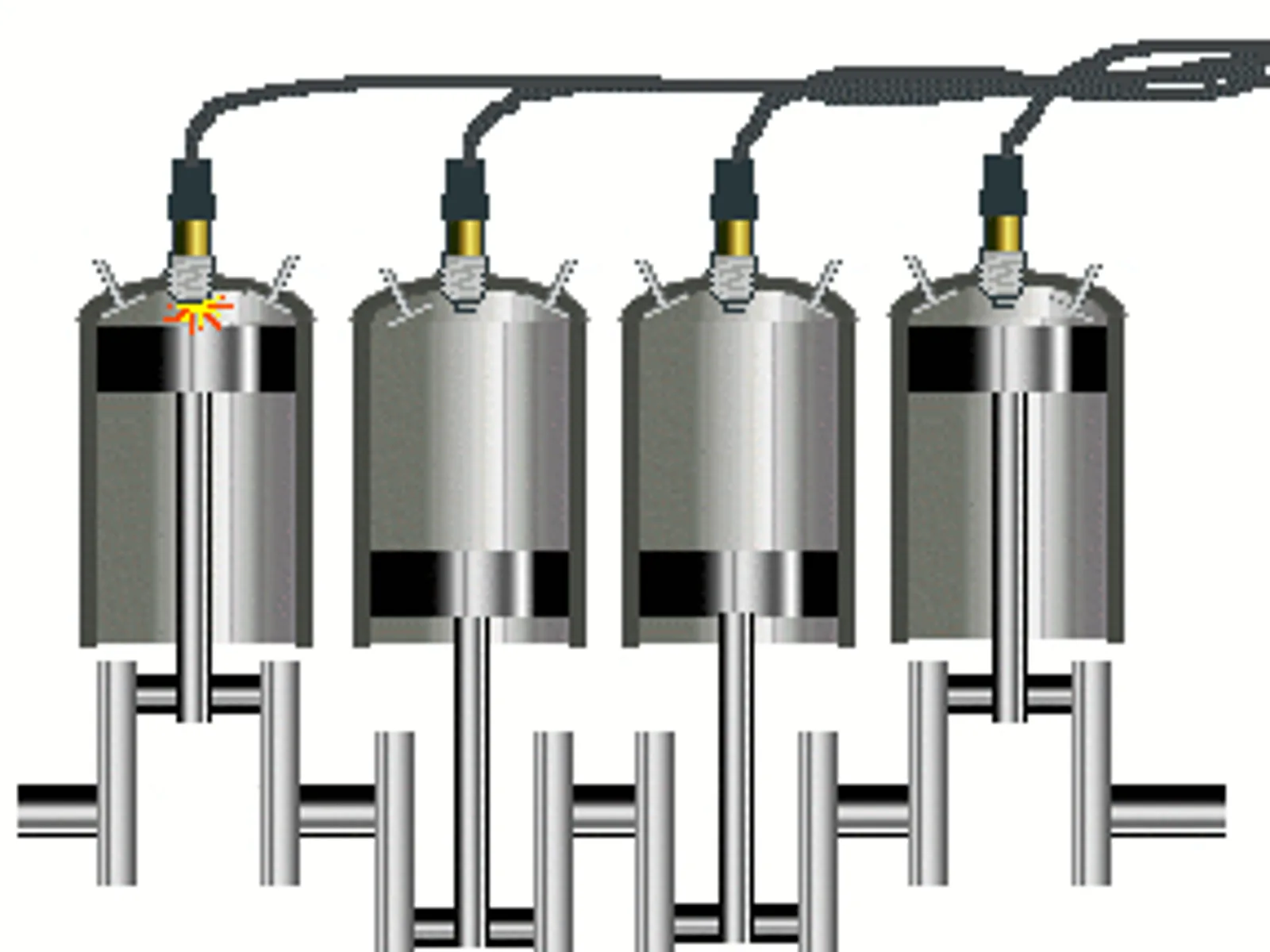
Litres, cc and cubic inches all measure the same swept volume. Bore, stroke, revs and boost decide what an engine does with it.
Engine displacement is the total volume swept by an engine's pistons, shown in cc, litres or cubic inches. It is calculated from bore, stroke and cylinder count. It hints at power, but revs and turbocharging also matter, so a smaller engine can match a larger one.
In Britain, a car registered before 1 March 2001 is still taxed by the size of its engine, and one under 1,549 cc (94.5 cu in) qualifies for a lower rate. Governments in several countries have scaled their charges to engine size, and carmakers have answered the same way every time: do not make the engine bigger, make it work harder. That is a large part of why engine size, once the headline number on every car, now tells you less than it used to.
What is engine displacement?
Engine displacement is the volume swept by all of an engine's pistons, counting the cylinders but not the combustion chambers. Picture a piston moving from the bottom of its cylinder to the top: the space it sweeps through is that cylinder's share, and the total for every cylinder is the engine's displacement.
It is the common shorthand for an engine's size, and by extension it hints at how much power the engine might make and how much fuel it should be expected to use. The power link runs through mean effective pressure and rotational speed. That is why displacement is used in advertising and in regulating vehicles.
Displacement is one ingredient in the power sum, alongside mean effective pressure and rotational speed.
What does engine size in cc mean?
The units differ by market. Metric figures use cubic centimetres, which equal millilitres, or litres. In the United States the figure is often in cubic inches instead, shown with several different abbreviations.
The two readings of the same engine often turn up side by side. A 1923-1930 Cadillac Series 353 was powered by a 353 cubic inch engine, which is 5.8 litres. A Chrysler Slant-6 of 225 cu in is a 3.7 litre. The 230 cu in straight-six in the Dodge Power Wagon is 3.8 L, and a Mercedes-Benz diesel V8 of 3996 cc is 243.9 cu in, or 4.0 litres. Going the other way, 1,549 cc is 94.5 cu in, and 50 cc is 3.1 cu in. So when you see 2.0L on a boot lid, it is a rounded version of a figure in cubic centimetres, and the cubic inch badges of older American cars say the same thing in other units.
What is happening inside the cylinder?
A cylinder is simply the space a piston travels through. Its wall is either a thin metal liner, also called a sleeve, inserted into the engine block, or the block itself with a hard coating such as Nikasil. Piston rings seal the gap between piston and wall, and they ride on a thin film of oil and not on bare metal. Where a liner wears out, a cylinder can sometimes be bored out and sleeved again.
The classic spark-ignition cycle explains why swept volume matters. A descending piston draws in a mixture of fuel and air. The rising piston compresses it, with a typical compression ratio of around 9-10:1. A spark ignites the mixture, and the hot gas expands to push the piston down. Finally the rising piston pushes the burnt gas out. The volume the piston sweeps on the way down is the volume of fresh charge the engine can take in, which is why displacement and power are linked. The four-stroke principle was patented by Alphonse Beau de Rochas in 1861, and Nicolaus Otto was the first to build a working engine on it, which is why it is also called the Otto cycle.
How do bore and stroke set displacement?
Three numbers make the sum: how long the stroke is, how big the circle of the bore is, and how many cylinders there are. Stroke is how far the piston travels. Bore is the diameter of the cylinder, and halving it and squaring it, then multiplying by pi, gives the area. Multiply the area by the stroke for one cylinder, then by the number of cylinders for the engine.
Try it on a real engine. The Mazda FE two-litre inline four has a bore and stroke of 86.0 mm by 86.0 mm. Work through the formula for four cylinders of that size and the answer lands almost exactly on the 2.0 in its name.
Because the formula assumes a piston going up and down in a round cylinder, it does not cope with every design. Run the same sum on the Wankel rotary, or on the oval-piston engine of Honda's NR motorcycles, and the comparison with a conventional engine can mislead. Makers and regulators therefore develop their own formulae for comparing the nominal displacement of unusual engines.
Bore and stroke: square, oversquare and undersquare
Two engines with the same displacement can be built very differently, and the ratio of bore to stroke is what separates them. An engine with equal bore and stroke is called square, with a ratio of 1:1. If the bore is wider than the stroke is long, it is oversquare, also called short-stroke. If the stroke is longer than the bore is wide, it is undersquare, or long-stroke.
| Engine | Bore x stroke | Ratio (bore/stroke) | Type |
|---|---|---|---|
| Nissan SR20DE | 86.0 mm x 86.0 mm | 1:1 | Square |
| BMW N45 (1.6 litre) | - | 1.167 | Oversquare |
| GMC 478 V6 | - | 1.33 | Oversquare |
| Ducati Panigale | - | 1.84:1 | Oversquare |
| Toyota 1KR-FE | 71 mm x 84 mm | 0.845:1 | Undersquare |
| Chrysler Slant-6 | 86 mm x 105 mm | 0.819:1 | Undersquare |
| Dodge Power Wagon straight-six | 83 mm x 117 mm | 0.709:1 | Undersquare |
| Wartsila two-stroke marine diesel | 960 mm x 2,500 mm | 0.384:1 | Undersquare |
An oversquare engine has room for more and larger valves in the cylinder head. The short stroke also lowers the maximum piston speed, so it can rev higher, and the lower peak piston acceleration eases the stress on the crank. Because those traits favour high revs, oversquare engines are often tuned to make peak torque at a relatively high speed. The cost is surface area. Larger pistons and heads lose more heat, so an excessively high ratio can reduce thermal efficiency, and a wide combustion chamber can make the air and fuel mix less evenly, which raises emissions. Such an engine tends to be less tall but wider than an undersquare one of the same displacement.
Oversquare designs are very common, and they allow higher rpm, and so more power, without excessive piston speed. Chevrolet and Ford small-block V8s are examples. Flat or boxer engines are typically oversquare, since any extra stroke would double the increase in overall width, and that matters most in a front-engined Subaru, where engine width limits how far the front wheels can turn. Even so, the Subaru EJ181 reaches peak torque by 3200 rpm.
Formula One shows the extreme. Strict limits on displacement mean power has to come from engine speed, and stroke ratios approaching 2.5:1 are allowed, enabling 18,000 rpm while still lasting several races.
The undersquare engine pays the opposite price. At any given engine speed, a longer stroke increases friction and puts more stress on the crankshaft because the piston accelerates harder at its peak. The smaller bore leaves less area for valves, so they must be smaller or fewer. Together, the small valves and high piston speed limit how high the engine can rev, and undersquare engines often reach peak torque at lower rpm than oversquare ones. Makers have been using the layout more lately in the push for efficiency and fuel economy.
It also fits the way many cars are packaged. Many inline engines mounted transversely in front-wheel-drive cars are undersquare, because the smaller bore gives a shorter engine and more room for the front wheels to steer. Volkswagen, Nissan, Honda and Mazda have used it widely. The BMW S54B32 engine, undersquare at 87 mm by 91 mm, set a world record for torque per litre, 114 N-m/L (1.38 lb-ft/cu in), among normally aspirated production engines until the Ferrari 458 Italia arrived.
Tax shaped older designs too. Many British makers used undersquare engines until the 1950s because the RAC horsepower tax was calculated from the cylinder bore, and a narrow bore cost less.
Why do small engines now match big ones?
Displacement is only one of the three ingredients in the power sum. Power comes from displacement, mean effective pressure and rotational speed, so an engine can make up for a smaller swept volume by turning faster. Where road taxes follow engine size, makers have often chosen higher-revving engines or turbocharging in place of a bigger displacement. The trend has spread beyond tax. Since 2010 the move towards downsizing, hybrids and electric drivetrains has left far fewer car names tied to an engine size.
The old naming habit shows what has been lost. American muscle cars wore their size on the badge: Ford's Mustang Boss 302 and 429, the Plymouth Roadrunner 383 and the Chevelle SS 396 and 454 from Chevrolet, as did the 1963-1968 BMW 1800, a 1.8-litre car, and the Lexus LS 400, which had a 3,968 cc engine.
The Wankel rotary is the clearest case of displacement as a rule and not a physical truth. It can produce more power for a given displacement, so it is generally taxed as 1.5 times its stated physical displacement: a 1.3 litre becomes effectively 2.0, and a 2.0 becomes effectively 3.0. The nominal figure counts a single chamber and comes out three times smaller than the physical displacement, a gap made up by the shaft turning at three times the speed of the rotor.
Which countries tax by engine displacement?
- Some European countries, in arrangements that predate the EU, charge one rate for engines over 1.0 litre and another at about 1.6 litres.
- In the United Kingdom, cars registered before 1 March 2001 are taxed by displacement, and later cars by exhaust emissions.
- In Japan, displacement is one of the factors, with overall size and power, that set the size class and therefore the road tax.
- Mopeds under 50 cc (3.1 cu in) can be ridden with minimal qualifications, which led to light motorbikes of about 49.9 cc.
- Road taxes do not follow displacement in many areas of the United States, in Canada outside Quebec, or in Australia and New Zealand, but a threshold of about 50 cc often decides whether a scooter or moped needs a licence.